 Custom
Quote
Wishbone Wedding Bands
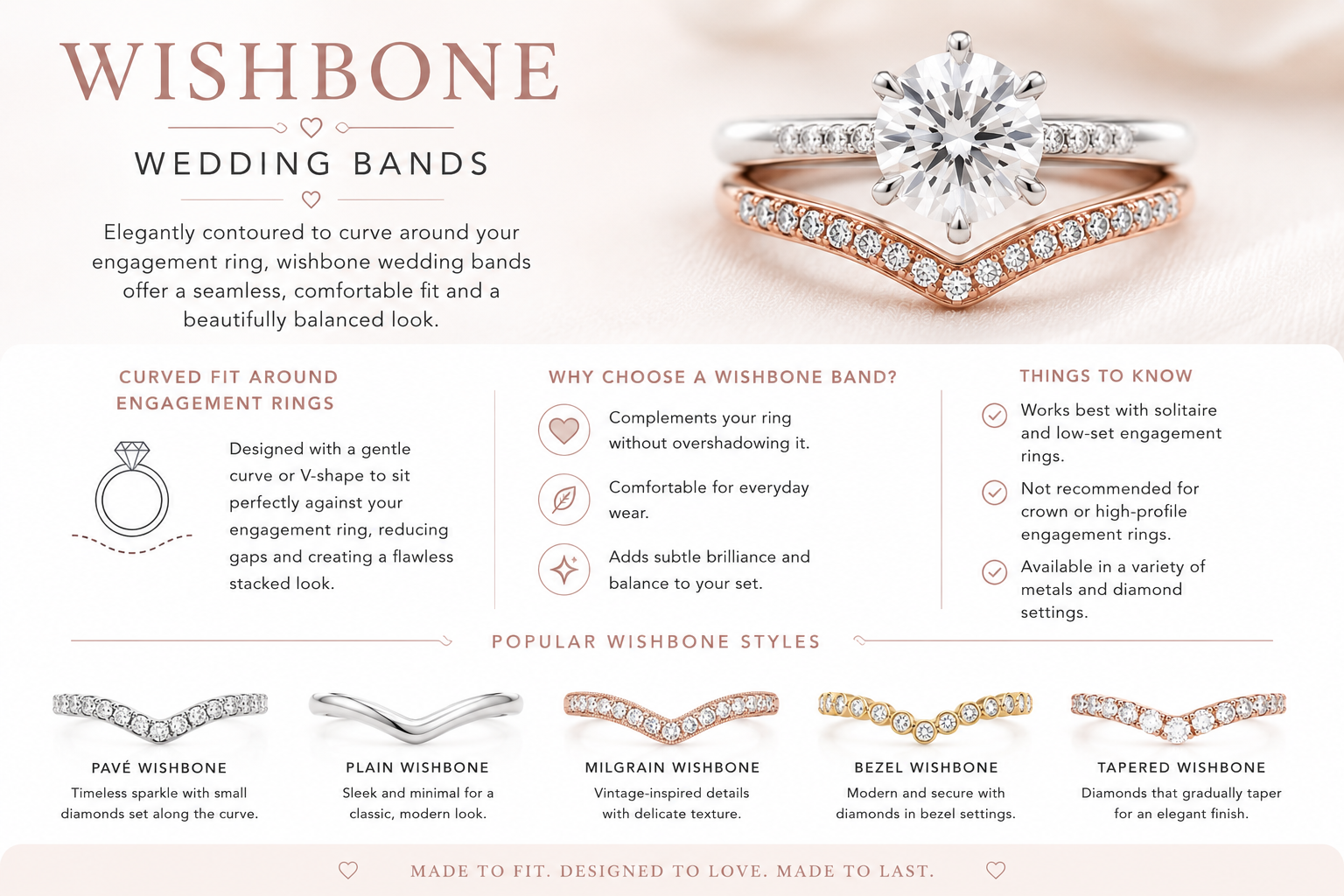
Wishbone wedding bands are curved V-shaped bands designed to sit neatly around an engagement ring instead of forcing a straight band to leave a gap. A wishbone band is especially useful when an engagement ring has a low basket, a protruding centre setting, a pear or teardrop centre stone, or a pointed tip protected by a V-prong. At OgilvieGems, each wishbone wedding band can be shaped to the exact contour of your ring so the set feels intentional, comfortable and secure for everyday wear.
What Is A Wishbone Wedding Band?
A wishbone wedding band is a curved band with a soft or defined V-shaped dip, made to nest around the centre setting of an engagement ring. Unlike a straight wedding band, it can follow the outline of a protruding basket, pear centre stone, teardrop silhouette or protective V-prong, helping the engagement ring and wedding band sit together as a considered bridal set.
Curved for clearance
The V curve creates space for the engagement ring setting, reducing the gap that often appears when a straight band meets a low-set centre stone.
Designed for nesting
A custom wishbone band can be shaped from your ring’s exact measurements so the curve follows the basket, shoulders and centre stone position.
Practical for daily wear
A good contour keeps the rings aligned, improves comfort between the fingers and helps prevent the wedding band from rubbing hard against delicate prongs.
The Visual Personality Of A Wishbone Band
Wishbone wedding bands have a graceful, directional look: the V draws the eye toward the engagement ring’s centre stone and makes the stack feel more sculpted. The effect can be minimal and refined in plain metal, romantic with pavé diamonds, or architectural when the V is sharper and more defined.
Soft and romantic
A shallow wishbone curve creates a gentle frame around the engagement ring without dominating the centre stone.
Defined and modern
A deeper V gives the wedding band a more noticeable outline and works well when the engagement ring has a stronger central profile.
Beautiful with pear shapes
For a pear or teardrop engagement ring, the wishbone curve can echo the pointed tip and help the bridal set feel balanced rather than forced together.
Stack-friendly
A wishbone band can be worn alone, paired with an engagement ring, or combined with a second curved band for a layered ring stack.
Proportions, Depth And Fit
The most important proportion in a wishbone wedding band is not only the band width, but the depth and angle of the V. The curve must be deep enough to clear the engagement ring, but not so exaggerated that it catches, twists or leaves the set looking disconnected when worn on the finger.
V depth
A shallow V suits many solitaire rings, while a deeper V may be needed for a low basket, a larger centre stone or a pear ring with the pointed tip facing down the finger.
Band width
Slim bands look delicate beside fine engagement rings, while wider bands provide more presence and can balance a larger centre stone.
Shoulder alignment
The curve should meet the engagement ring shoulders cleanly so the two rings look like a set rather than separate pieces competing for space.
Centre stone measurements
With pear and teardrop rings, the length-to-width ratio affects how far the centre stone extends and how much clearance the wishbone band needs.
Brilliance, Diamonds And Light Performance
A wishbone wedding band can be plain metal or diamond-set, and the best choice depends on how much sparkle you want around the engagement ring. When pairing with a pear centre stone, it is useful to consider the stone’s bow-tie visibility, prong layout and overall outline so the band enhances the ring rather than distracting from it.
Plain metal clarity
A polished plain wishbone band gives a clean outline and lets the engagement ring carry the main brilliance.
Diamond-set curve
Small diamonds along the V can brighten the contour and make the wedding band feel integrated with a pavé engagement ring.
Avoid visual crowding
If the engagement ring already has a busy halo or detailed shoulders, a simpler wishbone band may preserve the centre stone’s impact.
Pear centre balance
On pear rings, the wishbone should not compete with the teardrop outline, especially if the centre stone has a visible bow-tie or a pronounced pointed tip.
Durability Depends On Contact Points
A wishbone wedding band should not grind against the engagement ring’s prongs, gallery or V-prong. Poor spacing can loosen stones, flatten metal over time or create scratches where the rings meet. For daily wear, OgilvieGems recommends checking the clearance, matching compatible metals where possible and ensuring the curve supports a close fit without forcing pressure onto the engagement ring setting.
Custom Wishbone Settings For A Better Nest
The best wishbone wedding band is shaped around the engagement ring you will actually wear. A custom process allows the jeweller to measure the setting height, centre stone position, prong placement and shoulder width before defining the exact curve.
This is particularly important for pear and teardrop engagement rings, where the point direction, pointed tip and V-prong can change how much space the wedding band needs. A careful contour helps the rings sit comfortably while protecting the engagement ring’s most delicate areas.
Custom Design ProcessPlain wishbone band
A timeless option for clients who want a clean curved outline and minimal maintenance.
Pavé wishbone band
A diamond-set curve adds sparkle across the V and pairs well with pavé shoulders or a diamond-accented engagement ring.
Open-contour design
Useful when extra clearance is required around a low basket or centre stone, provided the structure remains strong enough for everyday wear.
Direction: How The V Sits On The Finger
Point direction affects the entire look of a wishbone bridal set. Most wishbone wedding bands are worn with the V pointing toward the engagement ring centre stone, but the exact orientation depends on the engagement ring’s shape, whether the ring is worn above or below the wedding band, and how the set feels in daily movement.
V pointing toward the centre stone
This is the classic arrangement because the wedding band visually frames the engagement ring and draws attention inward.
Pear point direction
If a pear engagement ring is worn with the pointed tip facing down the finger, the wishbone can echo that line and create a harmonious teardrop-inspired set.
Above or below the engagement ring
Some clients wear the wedding band below the engagement ring; others add a second curved band above it for symmetry and extra presence.
Comfort while wearing
The direction should feel natural when the hand opens and closes, with no sharp edge pressing into adjacent fingers.
Choosing Metals For Wishbone Wedding Bands
Metal choice affects colour, durability, maintenance and how visually connected the wedding band feels beside the engagement ring. Matching the engagement ring metal is the safest way to create a seamless set, while a mixed-metal wishbone band can create contrast if the proportions are carefully planned.
Platinum
Platinum is durable, naturally white and well suited to daily-wear bridal sets, especially where the rings touch or sit closely together.
18ct yellow gold
Yellow gold gives a warm, classic look and can make a plain wishbone band feel rich even without diamonds.
18ct white gold
White gold offers a bright, elegant appearance and is often chosen to match white-metal engagement rings.
18ct rose gold
Rose gold adds a soft blush tone and works beautifully when the client wants a romantic contrast against a diamond centre stone.
Lab-Grown And Mined Diamonds In Wishbone Bands
Wishbone wedding bands can be set with either lab-grown or mined diamonds, depending on budget, preference and the engagement ring they will accompany. For small accent diamonds, consistency in colour, clarity and cut is often more important than size, because the stones must sparkle evenly across the curved V.
Lab-grown accent diamonds
Lab-grown diamonds can offer strong value and allow more sparkle along the wishbone curve for a given budget.
Mined accent diamonds
Mined diamonds remain a traditional choice and can be matched carefully to the engagement ring’s existing diamond accents.
Matching appearance
Accent diamonds should be selected to complement the engagement ring so the wedding band does not look too bright, too warm or mismatched.
Secure setting style
Small diamonds need precise setting work along the curve, as poor alignment is more visible on a V-shaped band.
Common Mistakes When Buying A Wishbone Band
The biggest mistake is choosing a wishbone wedding band by appearance alone without checking how it sits against the engagement ring. A band that looks beautiful in isolation may still leave an awkward gap, press against a prong or sit at the wrong angle when worn with the actual ring.
Buying the curve too shallow
If the V does not clear the basket or centre stone, the rings may sit apart or rub in the wrong place.
Ignoring the engagement ring profile
Low-set rings, pear stones, teardrop outlines and V-prong settings often need more precise contouring than a generic curved band provides.
Choosing width without balance
A very thin band can look underpowered beside a large centre stone, while a heavy band can overwhelm a delicate engagement ring.
Forgetting long-term maintenance
Diamond-set curves need periodic checks to confirm that stones remain secure and that the band is not rubbing the engagement ring.
How To Buy The Right Wishbone Wedding Band
The right wishbone wedding band should look intentional with your engagement ring, feel comfortable on your hand and be practical for the way you live. OgilvieGems can guide you through the contour, metal, diamond setting, budget and finish so the wedding band is made for your exact ring rather than a generic display shape.
Bring or reference the engagement ring
Accurate fitting depends on the engagement ring’s height, basket shape, prongs and centre stone outline.
Decide on plain or diamond-set
A plain band is elegant and low-maintenance, while a diamond-set wishbone adds sparkle and a more decorative bridal look.
Check comfort and spacing
The band should nest closely without pinching, catching or placing pressure on the engagement ring.
Request a custom quote
A custom quote allows the design to reflect your preferred metal, diamond choice, V depth, band width and ring size.
Wishbone Wedding Bands FAQ
What is a wishbone wedding band?
A wishbone wedding band is a curved V-shaped wedding band designed to sit around an engagement ring’s centre setting, reducing gaps and creating a more integrated bridal set.
Do wishbone wedding bands fit all engagement rings?
They can work with many engagement rings, but the fit depends on the setting height, basket shape, prong placement and centre stone outline. A custom contour gives the best result.
Are wishbone bands good for pear engagement rings?
Yes. A pear or teardrop engagement ring often pairs beautifully with a wishbone band because the V can echo the pointed tip and help the wedding band nest around the centre stone.
Does the point direction of a pear ring affect the wedding band?
Yes. If the pear pointed tip faces down the finger, the wishbone curve may need to follow that direction. The V-prong and the stone’s length-to-width ratio can also affect the required clearance.
Can a wishbone wedding band be diamond-set?
Yes. Wishbone bands can be plain metal or set with accent diamonds. Pavé or small shared-prong diamonds can add sparkle along the curve if the setting is made securely.
Will a wishbone wedding band damage my engagement ring?
A properly fitted band should reduce unwanted rubbing. Damage is more likely when the curve is too shallow, the rings press against each other or the band touches delicate prongs.
Can I wear a wishbone wedding band on its own?
Yes. Many clients wear a wishbone band alone as a sculptural wedding ring, although its V shape is usually chosen because it also nests well with an engagement ring.
Should I choose lab-grown or mined diamonds for a wishbone band?
Both are suitable. The best choice depends on your budget and preference, while the accent diamonds should be matched for colour, clarity and sparkle across the curve.
How do I order a custom wishbone wedding band from OgilvieGems?
Request a custom quote with details of your engagement ring, preferred metal, ring size and whether you want a plain or diamond-set band. OgilvieGems can then guide the contour and design.
Design A Wishbone Band That Fits Your Ring
Share your engagement ring details and preferred style, and OgilvieGems will help create a curved wishbone wedding band that nests beautifully, protects the setting and suits everyday wear.
Request A Custom Quote