 Custom
Quote
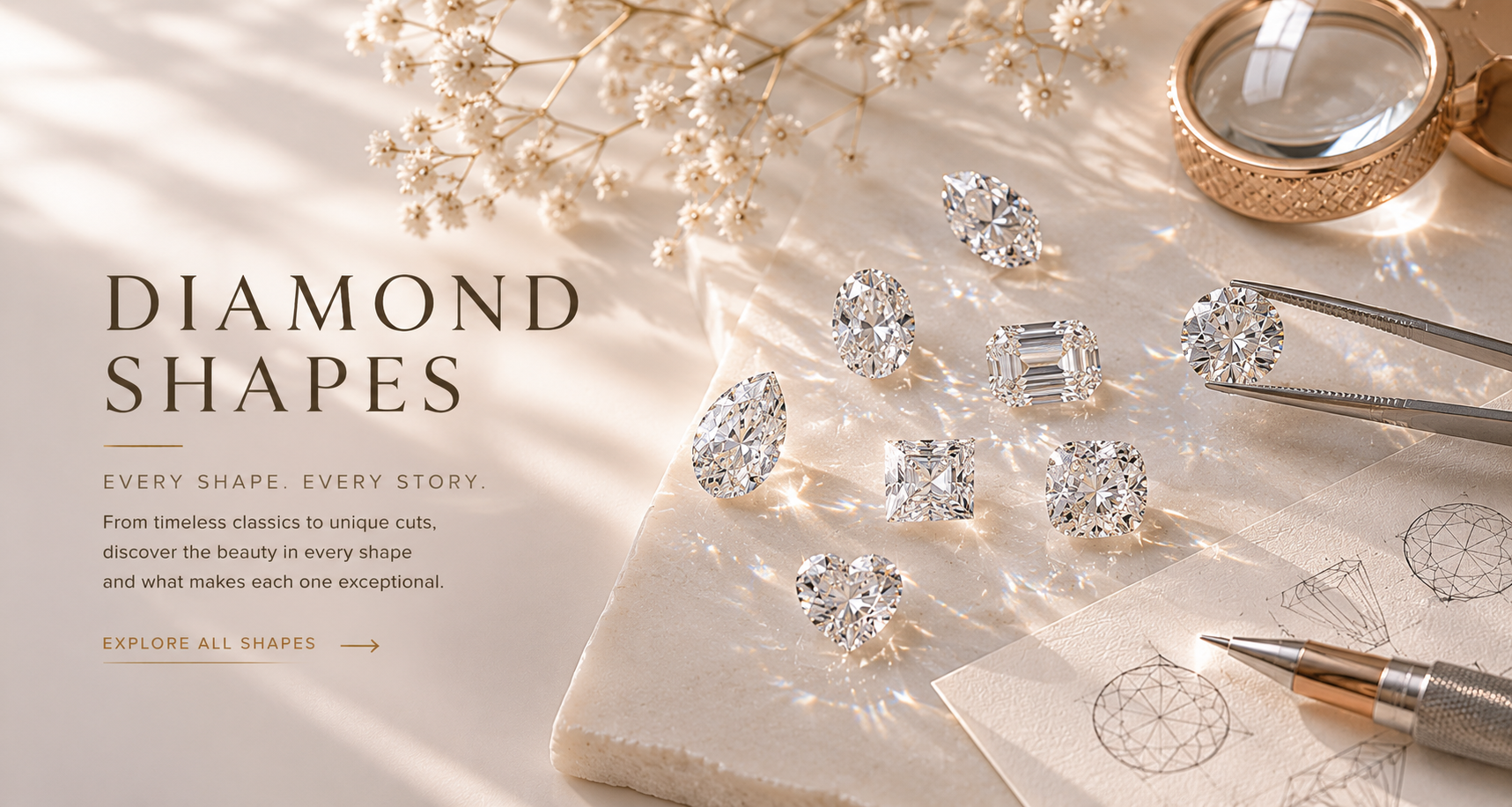
Diamond shape changes the entire personality of the ring.
Diamond shape affects sparkle, finger coverage, elegance, perceived size, setting style and the overall feeling of an engagement ring. This parent page compares the main diamond shapes as a decision guide, then routes each shape to its own dedicated engagement ring page for deeper detail.
Shape is not only about looks.
The same carat weight can look very different depending on shape. Round diamonds, oval diamonds, pear diamonds, radiant diamonds, cushion diamonds, emerald cuts, marquise diamonds and princess cuts all distribute weight differently and create different visual impressions.
Finger coverage
Elongated shapes often cover more finger length and can appear larger than round stones of similar carat weight.
Sparkle style
Brilliant-cut shapes usually give more sparkle, while step-cut shapes give a cleaner, mirror-like elegance.
Setting needs
Pear and marquise points need protection. Emerald cuts need clarity awareness. Ovals and pears need bow-tie review.
Personal style
Shape should match the wearer’s taste, hand, lifestyle and the feeling of the final ring.
Diamond shape comparison.
This table is designed for fast decision-making. It compares sparkle, visual size, durability, price efficiency, setting compatibility and the type of client each shape usually suits best.
| Shape | Sparkle Style | Visual Size | Durability Notes | Price / Spread | Best For |
|---|---|---|---|---|---|
| Round | Maximum traditional brilliance | Balanced but not the largest-looking per carat | No pointed corners; very practical when set well | Usually higher demand and price per carat | Timeless sparkle, classic solitaires, long-term style |
| Oval | Bright brilliance with possible bow-tie | Excellent finger coverage and elongation | Generally practical; symmetry and bow-tie must be reviewed | Strong visual size for the budget | Elegant modern engagement rings and elongated designs |
| Pear | Bright and directional | Strong visual length and spread | Pointed tip needs protection, often with a V-claw | Can look larger than its carat weight suggests | Soft distinctive rings with a unique silhouette |
| Marquise | Bright with dramatic length | Usually one of the largest-looking shapes | Both pointed ends need careful protection | Excellent spread when proportions are balanced | Drama, vintage influence and finger-lengthening effect |
| Radiant | Strong crushed-ice or brilliant sparkle | Good face-up size, square or rectangular | Corners should be protected by the setting | Good balance of sparkle and presence | Modern sparkle with geometric structure |
| Cushion | Soft sparkle, can vary widely | Moderate to strong depending on ratio | Rounded corners make it practical when built well | Can be efficient depending on cut style | Romantic, soft, vintage-inspired engagement rings |
| Emerald | Elegant flashes, not intense sparkle | Refined face-up presence | Clarity matters because inclusions show more easily | Often needs better clarity, affecting budget | Architectural, refined, understated luxury |
| Princess | Modern brilliance | Square presence | Sharp corners need protective setting design | Can be budget-efficient compared with round | Clean square modern engagement rings |
Best diamond shapes for different priorities.
Buyers rarely choose shape from technical data alone. Most clients choose based on a blend of beauty, practicality, budget, hand shape and the feeling they want the ring to carry.
Best for sparkle
Round brilliant remains the benchmark. Radiant, oval, pear and cushion can also sparkle beautifully when cut well.
Best for looking larger
Oval, marquise and pear diamonds often appear larger because they spread length across the finger.
Best for timeless style
Round diamonds are the most classic. Oval diamonds have become a modern timeless choice for many clients.
Best for modern design
Radiant, emerald and elongated cushion shapes often suit clean modern settings and strong design lines.
Best for vintage romance
Cushion, marquise, pear and emerald cuts can work beautifully with vintage-inspired details, milgrain, halos and antique-style profiles.
Best for daily wear
Round, oval, cushion, radiant and emerald shapes can all work well daily. Pointed shapes need more thoughtful protection.
Popular diamond shapes at a glance.
This section gives the overview only. Each shape should have its own dedicated page for deeper SEO, buying guidance and examples.
Round diamonds
Classic, brilliant and timeless. Round diamonds are often chosen for traditional sparkle and easy design versatility.
Oval diamonds
Elegant and elongated. Oval diamonds are popular for finger-lengthening engagement rings and strong visual size.
Pear diamonds
Distinctive and directional. Pear diamonds can feel graceful and dramatic, but the pointed tip needs protection.
Radiant diamonds
Modern and bright. Radiant diamonds can be square or rectangular and often deliver strong sparkle.
Cushion diamonds
Soft and romantic. Cushion diamonds have rounded corners and can feel warmer and gentler than sharper shapes.
Emerald cuts
Elegant and architectural. Emerald cuts show long step facets and require more clarity awareness.
Elongated shapes are popular for a reason.
Oval, pear, marquise, radiant and elongated cushion diamonds often create longer visual lines on the finger. They can also feel larger face-up than some deeper stones of similar carat weight.
The trade-off is that proportions, symmetry and setting protection become more important.
Explore Oval RingsBow-tie effect
Oval, pear and marquise diamonds can show a darker bow-tie area. Some is normal, but severe bow-tie should be reviewed.
Ratio matters
Length-to-width ratio affects whether a stone feels short, balanced, elongated or dramatic.
Tip protection
Pointed shapes need protective settings around the tips to reduce exposure during daily wear.
Different shapes sparkle differently.
Sparkle is influenced by cut quality, facet style, proportions, polish, symmetry and how the stone is set. Shape gives the character, but quality gives the performance.
Brilliant cuts
Round, oval, pear, radiant, marquise and many cushion diamonds are designed for strong sparkle and light return.
Step cuts
Emerald cuts show long, clean flashes rather than crushed sparkle. They feel refined, calm and architectural.
Mixed personality
Some cushions and radiants can vary widely. Always review the individual stone, not only the shape name.
Shape also affects practicality.
Engagement rings are often worn daily. The centre stone shape influences height, setting exposure, durability concerns and how the ring may catch on everyday objects.
Pointed shapes
Pear and marquise diamonds can be beautiful, but the tips must be protected carefully in the design.
Large face-up shapes
Ovals, pears and marquise diamonds can appear visually larger, but may need careful setting balance.
Step-cut clarity
Emerald cuts can show inclusions more easily, so clarity and stone selection become more important.
How diamond shape affects price and visual size.
Carat weight is not the same as visible size. Some shapes hold more weight underneath the stone, while others spread more across the finger.
Round diamonds
Round diamonds are highly demanded and often command stronger pricing. They are chosen for brilliance, not usually for maximum face-up size per rand.
Elongated shapes
Oval, pear and marquise diamonds often provide stronger visual spread, helping the ring appear larger without necessarily increasing carat weight.
Step cuts
Emerald cuts may need higher clarity because inclusions are easier to see. A lower clarity grade that works in a radiant may not work visually in an emerald cut.
How shape affects the ring setting.
The centre stone shape controls the entire build: claw placement, halo shape, hidden halo design, wedding band fit, ring height, side-stone proportions and long-term wearability.
| Shape | Setting Notes | Pairs Well With | Watch Carefully |
|---|---|---|---|
| Round | Works with almost every classic setting | Solitaire, halo, hidden halo, three-stone | Proportions and claw balance |
| Oval | Needs symmetry and careful north-south balance | Solitaire, hidden halo, side stones, pavé bands | Bow-tie effect and stone tilt |
| Pear | Direction matters: point up, point down or east-west | V-claw settings, halos, asymmetrical details | Tip protection and wedding band fit |
| Emerald | Looks powerful in clean architectural settings | Solitaire, bezel, three-stone, tapered baguettes | Clarity, windowing and proportions |
| Radiant | Can be square or rectangular | Solitaire, halo, hidden halo, three-stone | Corner protection and crushed-ice preference |
| Marquise | Creates dramatic length and vintage influence | Solitaire, east-west, vintage halos | Tip protection, bow-tie and symmetry |
Common diamond shape mistakes to avoid.
A beautiful diamond shape still needs the right stone selection and setting design. These are the mistakes we would rather help clients avoid before manufacturing begins.
Choosing only by carat weight
Carat weight does not guarantee visual size. Proportions, depth, table, ratio and shape all affect how large the diamond appears once set.
Ignoring bow-tie in elongated shapes
Oval, pear and marquise diamonds can show bow-tie. Some is normal, but severe darkness across the centre can affect beauty.
Setting pointed shapes without protection
Pear, marquise and princess diamonds need careful protection around points and corners to reduce vulnerability during wear.
Choosing emerald cuts without clarity awareness
Emerald cuts are elegant because they are open and clean. That same openness means inclusions can be more visible.
Making every setting too delicate
Delicate rings are beautiful, but every shape still needs enough structure, claw strength and support for real-life wear.
Forgetting the wedding band
Shape, setting height and basket design can affect whether a wedding band sits flush, curved, nested or with a visible gap.
Explore each diamond shape in detail.
This page is the parent overview. The pages below should carry the deeper search intent for each individual shape.
Oval Diamond
Elongated, elegant and popular for finger-lengthening engagement ring designs. Strong visual spread, but bow-tie and ratio need review.
→Round Diamond
Classic, brilliant and timeless. The benchmark for sparkle and symmetry, but often less size-efficient per carat than elongated shapes.
→Pear Diamond
A soft teardrop shape with direction, elegance and visual length. The pointed tip should be protected carefully.
→Radiant Diamond
A square or rectangular brilliant shape with modern energy, strong sparkle and excellent setting versatility.
→Cushion Diamond
Soft corners, romantic proportions and a gentler square or rectangular look. Often chosen for warmth and vintage softness.
→Elongated Cushion Diamond
A longer cushion silhouette that gives more finger coverage while keeping the softer cushion personality.
→Emerald Cut Diamond
Step-cut, elegant and architectural, with a clear window into the stone. Clarity and proportions matter strongly.
→Princess Square Diamond
Modern square shape with crisp lines, strong geometry and sharp corners that need suitable setting protection.
→Marquise Diamond
Long, dramatic and finger-lengthening, with exceptional visual spread and pointed ends that need careful protection.
→Diamond Shapes FAQ
Which diamond shape is best for an engagement ring?
There is no single best diamond shape. The right shape depends on the wearer’s style, hand shape, budget, sparkle preference, setting type, lifestyle and how practical the ring needs to be for daily wear.
Which diamond shape looks the biggest?
Elongated shapes such as oval, pear, marquise, radiant and elongated cushion can often look larger on the finger than round diamonds of the same carat weight because of their spread, length and face-up coverage.
Which diamond shape sparkles the most?
Round brilliant diamonds are traditionally known for the strongest overall sparkle. Radiant, oval, pear, marquise and cushion diamonds can also be very brilliant, but their performance depends strongly on cut quality and proportions.
Which diamond shape is most timeless?
Round brilliant diamonds are usually considered the most timeless. Oval diamonds have also become a modern classic because they combine elegance, brilliance and finger coverage.
Which diamond shape is best for a larger-looking ring?
Oval, marquise and pear diamonds often give excellent visual size because they spread length across the finger. Radiant and elongated cushion diamonds can also give strong presence depending on their proportions.
Which diamond shape is best for sparkle and budget together?
Radiant, oval and cushion diamonds often balance sparkle and visual size well. Round diamonds may sparkle the most, but usually carry stronger demand and can cost more per carat.
Are some diamond shapes more delicate?
Yes. Shapes with points, such as pear, marquise and princess diamonds, need protective settings around the tips or corners. Step-cut stones such as emerald cuts also require more careful clarity selection because inclusions can be easier to see.
What is the bow-tie effect?
The bow-tie effect is a darker area that can appear across the centre of elongated brilliant shapes such as oval, pear and marquise diamonds. Some bow-tie is normal, but severe bow-tie can affect the visual beauty of the stone.
Should I choose shape before choosing a setting?
Usually yes. The centre stone shape strongly influences the setting style, proportions, band design, wedding band fit, claw placement and how the ring looks on the hand.
Which diamond shapes suit hidden halo settings?
Oval, radiant, cushion, pear and round diamonds often work beautifully with hidden halo settings. The hidden halo must be designed around the exact stone shape and profile so the ring remains balanced and wearable.
Which diamond shape is safest for daily wear?
Round, oval, cushion, radiant and emerald shapes can all work well daily. Pear, marquise and princess shapes can also be worn daily, but their points or corners need suitable protection.
Which shape hides inclusions best?
Brilliant and crushed-ice styles such as round, radiant, cushion and some oval diamonds may hide inclusions better than step cuts. Emerald cuts show clarity more openly because of their long, mirror-like facets.
Choose the shape before finalising the ring.
The centre stone shape influences the entire design. Once shape, ratio, stone type and budget are clear, the setting can be refined around the wearer.
Request A Custom Quote