 Custom
Quote
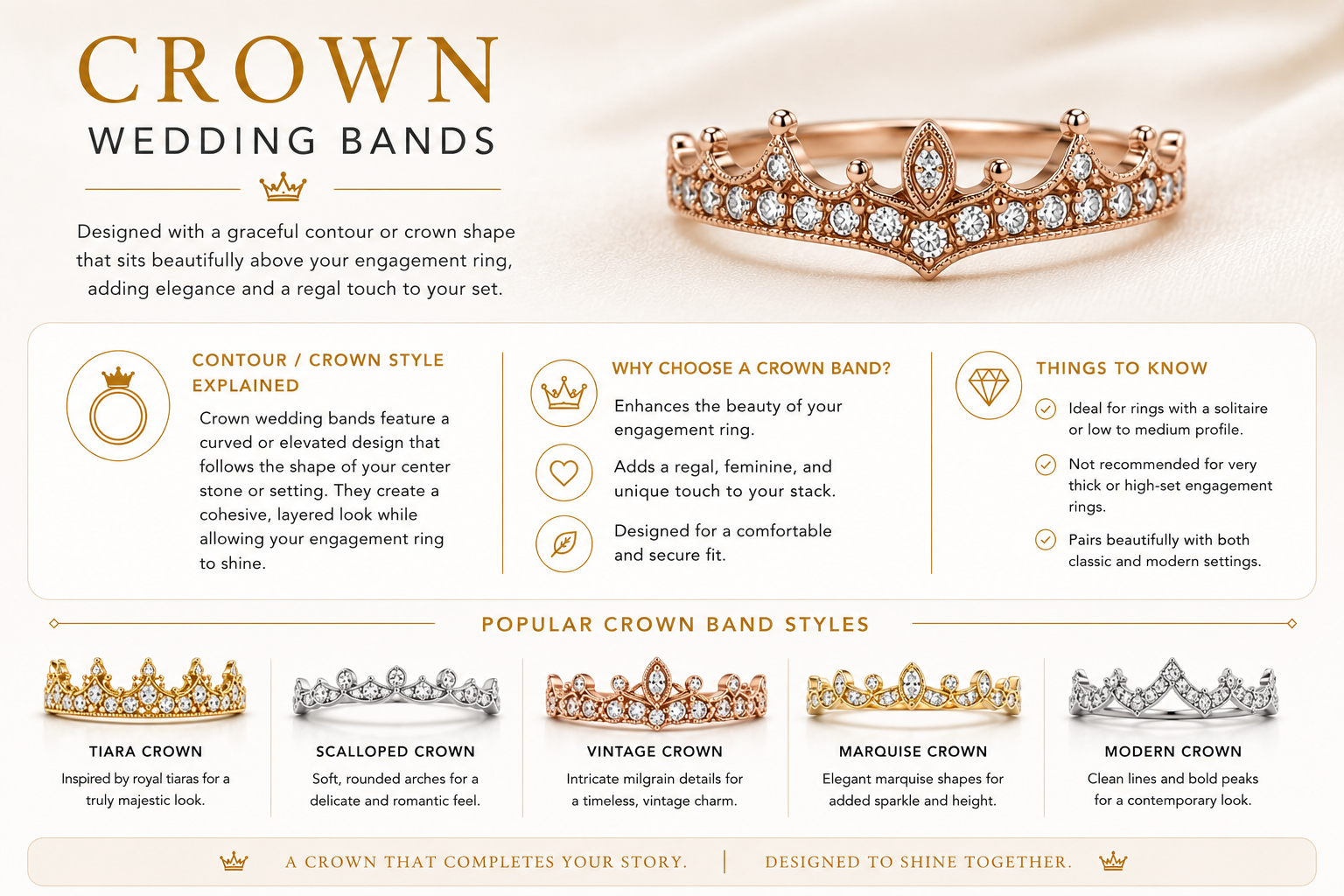
Crown Wedding Bands
Crown wedding bands are contoured wedding bands with a peaked, regal outline designed to frame an engagement ring rather than sit as a plain straight band. Their raised centre point can echo the pointed tip of a pear or teardrop diamond, create a crown-like stack above or below the centre stone, and add architectural symmetry to the bridal set. At OgilvieGems, crown bands are usually custom measured to your engagement ring so the point direction, height, curve, metal profile and diamond spacing feel intentional rather than improvised.
What Is A Crown Wedding Band?
A crown wedding band is a shaped wedding band with a lifted centre peak, curved shoulders or small graduated details that create a crown-like outline around an engagement ring. It is especially useful when a straight band cannot sit neatly against the ring because of a low basket, a large centre stone, a hidden halo or a pear-shaped diamond with a pronounced pointed tip.
Designed Around The Engagement Ring
A crown band is not chosen by width alone. The curve, peak height and inner clearance should be designed around the exact engagement ring so the band frames the setting without pushing against claws, a basket or the centre stone.
A Framing Effect
The raised point can visually lift the centre of the stack and create a regal outline. This works beautifully with pear and teardrop engagement rings because the band can echo the point direction of the centre diamond.
Custom Fit Matters
Small changes in the crown angle can change the entire look. A band that is too shallow may look unrelated, while a band that is too steep may compete with the engagement ring instead of supporting it.
The Visual Personality Of Crown Bands
Crown wedding bands suit clients who want a bridal stack with structure, softness and a clear focal point. They can look minimal in polished gold, romantic with small diamonds, or dramatic when the peak is more pronounced. The style is about framing, not simply adding another ring.
Regal And Sculptural
The centre peak gives the stack a designed, architectural finish. It can make a solitaire feel more complete without needing a large additional diamond band.
Softly Contoured
A crown band can still feel delicate when the shoulders are rounded and the peak is gently lifted. This is ideal for engagement rings with softer claw work or fine pavé shoulders.
Best With A Clear Centre Line
The style is strongest when the engagement ring has a defined central axis. Pear and teardrop shapes work especially well because the crown peak can follow or balance the pointed tip.
Stacking With Intention
A second band can be added later, but the first crown band should establish the visual rhythm. Matching curve, width and diamond size keeps the stack cohesive.
Proportions, Point Height And Finger Coverage
The beauty of a crown wedding band depends on proportion. The band must relate to the size of the centre stone, the engagement ring shank, the height of the setting and the wearer’s finger length. With pear or teardrop diamonds, the centre stone’s length-to-width ratio is also important because a longer stone may need a taller or more elongated contour.
Peak Height
A low peak creates a subtle nestling effect, while a higher peak creates a bolder crown silhouette. The correct height depends on the engagement ring’s lower profile and the gap the band must bridge.
Band Width
A fine band keeps attention on the engagement ring, while a wider crown band gives more visual presence. The width should not overpower the centre stone or make the stack feel heavy.
Length-To-Width Ratio
A pear diamond with a slender length-to-width ratio often suits a more elongated crown curve. A rounder teardrop outline may look better with a softer, lower peak.
Diamond Scale
If the crown band uses small diamonds, their size should be matched to the engagement ring’s pavé or claw scale. Oversized melee can make the crown look bulky.
Brilliance And How The Crown Band Affects The Ring
A crown band does not change the cut quality of the engagement ring, but it can change how the eye reads sparkle, symmetry and contrast. Around pear and teardrop centre stones, the band can draw attention to the point direction and help balance visual effects such as a bow-tie across the stone.
Enhancing The Centre Stone
A clean crown outline can lead the eye toward the centre diamond. This is especially effective when the peak sits in visual conversation with the pointed tip rather than touching it.
Managing Bow-Tie Visibility
Pear diamonds can show a bow-tie depending on cut, lighting and viewing angle. A well-proportioned crown band frames the stone without adding dark visual clutter near the centre.
Diamond Band Sparkle
Pavé or shared-prong diamonds add shimmer around the engagement ring. For everyday wear, the diamonds should be bright enough to complement the centre stone without becoming the main focal point.
Metal Reflection
Polished metal surfaces reflect light into the stack and can make the contour feel more defined. This is useful for clients who prefer a crown shape without a fully diamond-set band.
Durability Risks With Poorly Fitted Crown Bands
The main durability risk is contact. If the crown point, shoulders or diamond settings rub against the engagement ring claws, basket or gallery, both rings can wear down over time. A crown band should be checked for clearance, point alignment and pressure points before production. This is especially important near a pear diamond’s pointed tip and V-prong, where a poorly placed band can create avoidable wear.
Crown Band Setting Styles
Crown wedding bands can be made as plain polished contours, diamond-set bands, mixed metal accents or more intricate crown designs with graduated details. The right choice depends on whether the wearer wants the wedding band to disappear into the bridal set or become a visible design feature.
For engagement rings with a pear or teardrop centre stone, the setting style should respect the point direction and the V-prong position. The crown peak should frame the ring, not crowd the most delicate part of the setting.
Custom Design ProcessPlain Crown Band
A plain metal crown band is elegant, durable and easy to wear daily. It highlights the shape of the contour without adding competing sparkle.
Diamond-Set Crown Band
Small pavé or shared-prong diamonds create a bright crown effect. The diamond size and setting depth should be chosen to avoid bulk against the engagement ring.
Point Direction And How To Wear The Band
Point direction is one of the most important design decisions for a crown wedding band. The crown peak can point toward the engagement ring centre stone, away from it, or be used as part of a stacked pair. The best choice depends on the engagement ring profile, the pear or teardrop orientation and the desired silhouette on the finger.
Pointing Toward The Centre Stone
This creates a close framing effect and is often chosen when the crown peak is intended to echo the pointed tip of a pear diamond. Clearance around the V-prong must be carefully checked.
Pointing Away From The Centre Stone
Turning the crown away can create a more open, elongated look. It is useful when the engagement ring setting is low or when the wearer wants more visible negative space.
Above Or Below The Engagement Ring
Some bridal sets look better with the crown band worn below the engagement ring, while others balance beautifully above it. The correct placement is determined by finger shape and the ring’s setting geometry.
Future Stack Planning
If a second contour band may be added later, the first crown band should be designed with that future stack in mind. This prevents mismatched angles and uneven spacing.
Choosing Metals For Crown Wedding Bands
Metal choice affects the look, maintenance and longevity of a crown wedding band. Because shaped bands can have small contact zones near an engagement ring, the metal should be selected with both aesthetics and everyday wear in mind.
Platinum
Platinum is durable, naturally white and well suited to fine diamond-set crown bands. It is a strong choice for clients who want a cool-toned bridal stack with long-term wear resistance.
18ct Yellow Gold
Yellow gold gives a warm, classic contrast and can make the crown outline more visible. It works well with both plain and diamond-set contours.
18ct White Gold
White gold offers a bright, polished look and pairs neatly with many engagement ring styles. Rhodium maintenance should be considered if the wearer wants a consistently icy white finish.
18ct Rose Gold
Rose gold adds softness and romance to the crown shape. It can be especially flattering when used to create contrast against a white metal engagement ring.
Lab-Grown And Mined Diamonds In Crown Bands
Crown wedding bands can be made with lab-grown diamonds or mined diamonds, depending on budget, preference and the diamonds already present in the engagement ring. For small band diamonds, matching colour, clarity and cut consistency is usually more important than origin alone.
Lab-Grown Diamond Bands
Lab-grown diamonds can offer excellent sparkle and value in a diamond-set crown band. They are a strong option when the wearer wants more diamond coverage within a defined budget.
Mined Diamond Bands
Mined diamonds are often selected to match an existing mined diamond engagement ring. The goal is a consistent visual result across the full bridal set.
Matching Existing Diamonds
Colour and size matching are important in crown bands because the diamonds sit close to the engagement ring. Mismatched melee can make the contour look uneven.
Plain Metal Alternative
A crown band does not need diamonds to feel special. A plain metal contour can be more practical for active wear and still create a strong crown silhouette.
Common Crown Band Mistakes To Avoid
Most crown band issues come from treating the design as a generic shape rather than a fitted companion to a specific engagement ring. A successful crown band should be measured, drawn and checked in relation to the exact ring it will be worn with.
Ignoring The Engagement Ring Profile
A low basket, hidden halo or wide gallery can prevent a crown band from sitting comfortably. Side-view measurements are just as important as the top-view outline.
Making The Peak Too Sharp
A sharp crown point can look dramatic in a sketch but uncomfortable or fragile in real life. The peak should be refined enough to wear daily.
Crowding The Pointed Tip
With pear and teardrop diamonds, the crown band must not press into the pointed tip or V-prong. A tiny clearance gap can prevent future rubbing.
Forgetting Ring Size Changes
Highly shaped bands can be more complex to resize than simple bands. It is worth confirming ring size carefully before manufacturing.
How To Buy A Crown Wedding Band
The best way to buy a crown wedding band is to start with the engagement ring, not the band. Bring or provide clear details of the ring’s top view, side profile, centre stone shape, setting height and desired stack style so the crown contour can be designed with accuracy.
Bring The Engagement Ring
A physical fitting allows the jeweller to check real clearance, curve and comfort. If the ring is not available, accurate photos and measurements are essential.
Decide On Stack Style
Choose whether you want the band to sit close, leave a deliberate gap or create a more sculptural crown outline. Each option changes the final design.
Confirm Daily Wear Needs
If the ring will be worn every day, consider a smoother profile, secure diamond settings and a metal that suits the wearer’s lifestyle.
Ask For A Custom Quote
A custom quote should consider metal, diamond origin, setting style, CAD design, hand finishing and whether the band must match an existing engagement ring.
Crown Wedding Bands FAQ
What is a crown wedding band?
A crown wedding band is a contoured band with a raised centre peak or crown-like outline. It is designed to frame an engagement ring, especially when a straight band would leave an awkward gap.
Do crown wedding bands work with pear engagement rings?
Yes. Crown bands can work very well with pear and teardrop engagement rings because the peak can echo the pointed tip or balance the point direction of the centre diamond.
Should the crown point face toward or away from the engagement ring?
Either can work. Pointing toward the centre stone creates a close framed look, while pointing away creates a more open stack. The best choice depends on the engagement ring height, V-prong position and desired style.
Can a crown band damage my engagement ring?
It can if it is poorly fitted. The band should not rub against claws, the basket, the gallery or the V-prong protecting a pear diamond’s pointed tip. Proper clearance is essential.
Can crown wedding bands be made without diamonds?
Yes. A plain polished crown band can be elegant, durable and practical. Diamonds add sparkle, but the crown shape itself can provide the design interest.
Are crown bands comfortable for everyday wear?
They can be very comfortable if the peak is refined, the edges are softened and the band is properly profiled. Comfort depends on thickness, point height, ring size and how the band sits beside the engagement ring.
Do crown bands need to be custom made?
Custom design is strongly recommended when the band must fit a specific engagement ring. Small differences in setting height, centre stone size and shoulder shape can change the required contour.
Can I use lab-grown diamonds in a crown wedding band?
Yes. Lab-grown diamonds are suitable for crown bands and can offer excellent value. Mined diamonds are also available, and the best choice depends on preference, budget and how closely the band must match the engagement ring.
How does a pear diamond’s length-to-width ratio affect the crown band?
A longer pear shape may suit a more elongated crown curve, while a rounder teardrop shape often pairs better with a softer, lower peak. The band should visually balance the centre stone.
Will a crown band hide a bow-tie in a pear diamond?
No wedding band can remove a bow-tie, because it is related to the diamond’s cut and light return. A well-designed crown band can, however, frame the diamond cleanly without making the bow-tie more noticeable.
Design A Crown Wedding Band Around Your Ring
Share your engagement ring details with OgilvieGems and we will help design a crown wedding band with the right contour, point direction, metal and finish for your bridal stack.
Request A Custom Quote