 Custom
Quote
Why Lab Diamonds Cost Less Than Natural Diamonds
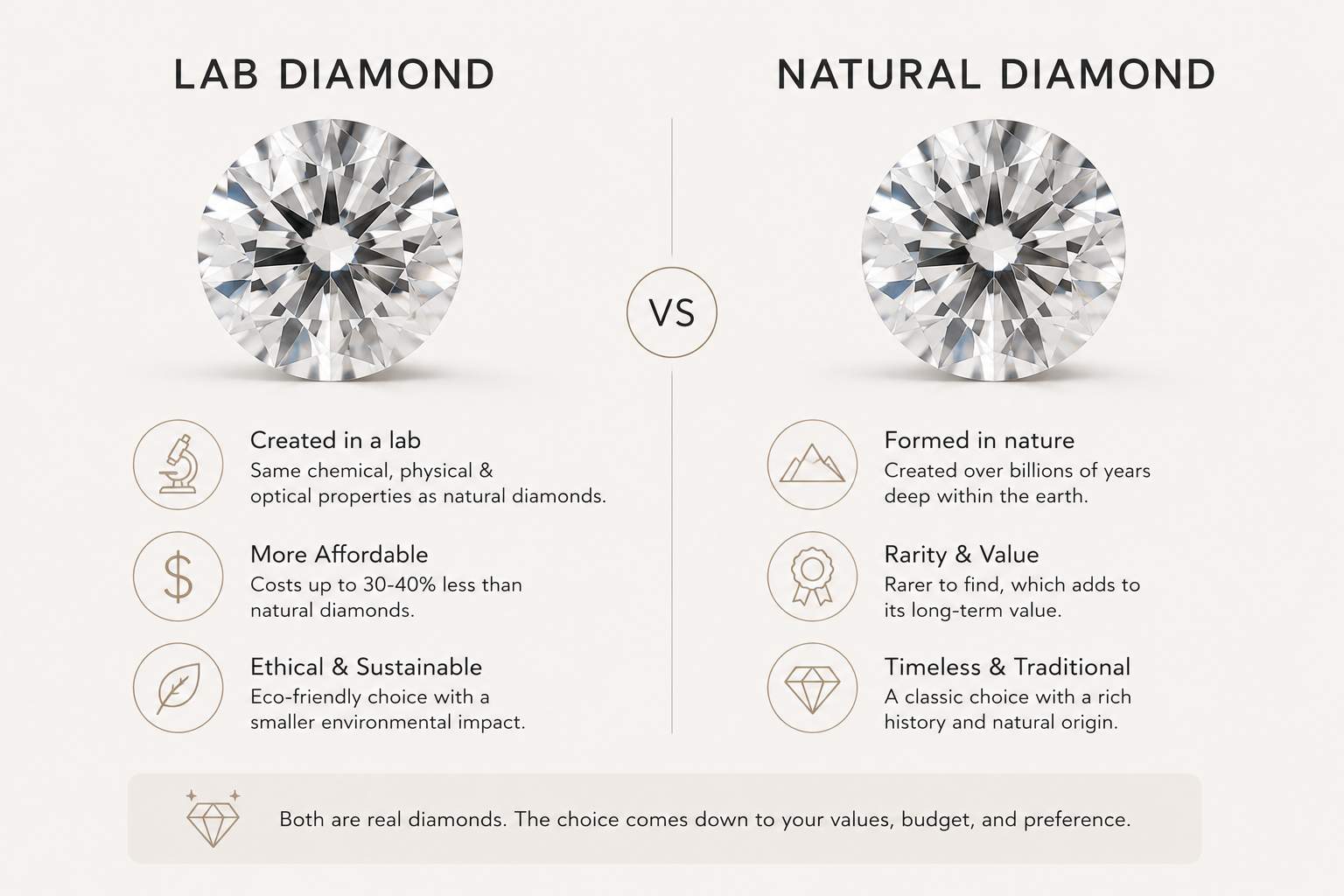
Lab diamonds cost less than natural diamonds mainly because their supply can be produced more predictably, scaled more efficiently and brought to market with fewer rarity-based price premiums. A lab diamond is still diamond, but its price is shaped by a different economic path. Natural diamonds carry geological rarity, extraction costs, sorting networks and long-established market traditions. Lab diamonds are created in controlled production environments, so availability, repeatability and competition place downward pressure on price. The result is a buyer-friendly option for clients who want a larger, better-cut or higher-colour diamond for the same engagement ring budget.
Why the price gap exists
The lower price of lab diamonds is not a sign that they are fake or decorative substitutes. It is the result of different economics. Natural diamonds are priced through geological scarcity, discovery, extraction, sorting, distribution and long-standing market perception. Lab diamonds are grown in repeatable production cycles, so suppliers can respond to demand more quickly and offer consistent qualities at competitive prices.
Supply is more controllable
Natural diamond supply depends on deposits formed over immense geological time. Lab diamond supply depends on production capacity, technology, energy, quality control and market demand, making availability more flexible.
Production can scale
As growth technology improves, producers can create more diamonds with predictable colour, clarity and sizes. Increased capacity creates competition, and competition usually reduces retail prices.
Rarity is priced differently
A natural diamond includes a rarity premium because it is recovered from the earth. A lab diamond may be chemically and optically diamond, but it does not carry the same geological scarcity premium.
The buyer gets more visual value
Because the centre stone often costs less, many clients can choose a larger carat weight, a higher colour grade, a cleaner clarity grade or a more detailed custom setting within the same budget.
How visual impact changes the value conversation
The price difference becomes especially clear when buyers compare how a diamond looks on the hand rather than only how it appears on a certificate. A lab diamond can make it possible to choose a visually generous shape, a finer make or a more refined ring design without moving into a much higher total budget.
Shape can amplify size
Some silhouettes appear larger for their carat weight because they spread across the finger differently. A pear diamond, with its teardrop outline, can feel elongated and elegant while still offering strong finger coverage.
Design personality matters
The same price saving can be used in different ways: a classic round solitaire, a cushion halo, an oval three-stone ring or a pear design with the point direction chosen for the wearer’s preferred visual effect.
Beauty is not only carat weight
A diamond that is well cut, bright and balanced can look more luxurious than a larger stone with weak light return. Lab pricing often lets clients prioritise cut quality instead of stretching budget only for size.
Why proportions still matter when the diamond costs less
A lower lab diamond price should not lead to careless selection. Proportions affect spread, symmetry, sparkle and overall elegance. Even when two diamonds have the same carat weight and similar grades, one may look noticeably better because the millimetre dimensions and cutting proportions are more attractive.
Carat is weight, not face-up size
A one-carat diamond can look compact or generous depending on how its weight is distributed. Comparing millimetre measurements helps buyers understand what they are actually seeing on the finger.
Length-to-width ratio changes the outline
In elongated shapes, the length-to-width ratio determines whether the diamond appears soft, balanced, slender or dramatic. This is important for ovals, emerald cuts, radiant cuts and pear designs.
Proportions influence price efficiency
A diamond that faces up well can give better visual value than a heavier stone that hides weight in depth. Good buying means comparing size, cut and appearance together, not chasing the cheapest price per carat.
Custom design should follow the stone
The best setting is designed around the chosen diamond’s actual measurements. This protects the stone, improves the proportions of the ring and prevents the finished piece from looking generic.
Brilliance, cut quality and the real reason to compare diamonds in person or by video
Lab diamonds can be beautiful, bright and lively, but they still vary from stone to stone. Price should never be judged on certificate grades alone. Cut precision, contrast pattern, polish, symmetry and light performance can make one diamond look far more desirable than another with similar listed specifications.
Cut affects perceived value
A well-cut diamond returns light attractively and appears more alive. This is one of the smartest areas to protect when a lab diamond allows more flexibility in the budget.
The bow-tie effect should be assessed
Many elongated brilliant styles can show a bow-tie across the centre. A slight bow-tie can be normal, but a dark, distracting one can reduce the beauty of the diamond even if the price looks appealing.
Certificates do not show everything
A grading report confirms important information, but it does not fully explain personality, light return or how the diamond performs in motion. Visual inspection remains important.
Cheaper should not mean dull
The purpose of choosing lab is often to unlock better visual quality for the budget. Selecting a lifeless diamond simply because it is inexpensive misses the main advantage.
Lower cost does not mean lower hardness
A lab diamond is diamond, so it is suitable for everyday engagement ring wear when correctly set and cared for. The risk is not that the stone is too soft; the risk is choosing a poor setting for the shape. For example, a pear diamond has a pointed tip that should be protected with a secure V-prong to reduce the chance of impact damage during daily wear.
How the setting can turn lab diamond savings into a better ring
Many buyers use the lower centre-stone price to improve the finished ring rather than simply spending less. This may mean a more refined basket, stronger claws, a hand-finished band, a hidden halo, side stones or a design that is custom made around the diamond’s exact measurements.
A good setting also protects the diamond and improves comfort. In shapes with a pointed tip, such as a pear, the V-prong is not only a style detail; it is a practical protection point. The right setting helps the ring feel intentional rather than chosen from a standard catalogue.
Custom Design ProcessSolitaire settings
A solitaire keeps attention on the diamond and is often the cleanest way to show the size advantage a lab diamond can offer within a fixed budget.
Halo and hidden halo details
A halo can increase visual spread, while a hidden halo adds detail from the side view without changing the top silhouette too much.
Three-stone rings
Lab diamond pricing can make side stones more accessible, allowing a balanced design with meaningful presence rather than a centre stone alone.
Direction, orientation and how design choices affect perceived value
Diamond value is not only economic; it is also emotional and visual. The same lab diamond can feel modern, classic, romantic or dramatic depending on how it is oriented and set. This is where custom design helps buyers convert a pricing advantage into a ring that feels personal.
Point direction changes the mood
In a pear or teardrop diamond, setting the point direction toward the fingertip can elongate the hand, while setting it toward the wrist can feel softer and more unusual.
Orientation affects finger coverage
North-south settings usually create length, while east-west settings can create a wider visual line. The right choice depends on hand shape, lifestyle and preferred style.
Direction should suit the wearer
A lower lab diamond price gives more freedom to consider orientation, proportions and setting detail rather than being forced into the smallest acceptable stone.
Metal choice and total ring price
The diamond is often the largest cost in an engagement ring, but it is not the only cost. Metal selection, setting complexity and hand-finishing all influence the final quote. Choosing a lab diamond can free budget for a more suitable metal or a stronger setting without increasing the total spend.
Platinum
Platinum is dense, durable and naturally white, often chosen for premium engagement rings. It can cost more than gold, so lab diamond savings may help absorb the metal upgrade.
White gold
White gold offers a bright, classic look and is popular for diamond engagement rings. It may require rhodium maintenance over time, which should be considered when comparing long-term costs.
Yellow and rose gold
Warmer metals can make near-colourless diamonds appear inviting and romantic. They can also create contrast that gives the ring more personality.
Setting labour
Fine claws, precise stone seats, hand finishing and custom CAD work all add value. A lower centre-stone cost can make better craftsmanship more accessible.
Lab diamonds and natural diamonds are priced by different value systems
The cost difference is best understood as a difference in value drivers, not a simple better-or-worse ranking. Natural diamonds are valued for geological origin, rarity, long-established market demand and tradition. Lab diamonds are valued for visual beauty, diamond material, grading specifications, production efficiency and affordability.
Origin affects pricing
Natural diamonds are recovered from the earth, and that origin carries a scarcity premium. Lab diamonds are grown in controlled environments, so the origin story does not command the same premium.
Technology increases availability
As HPHT and CVD production improves, more polished lab diamonds can enter the market. Greater availability usually lowers prices, especially in common sizes and grades.
Resale expectations differ
Buyers should not choose a lab diamond expecting strong resale performance. The main value is usually in enjoying a larger or finer diamond for the purchase price, not in future liquidation.
Both can be meaningful choices
A natural diamond may appeal to someone who values geological rarity. A lab diamond may appeal to someone who values size, specifications and budget efficiency. The right choice depends on priorities.
Common mistakes when comparing lab diamond prices
Because lab diamond pricing can look dramatically lower, buyers sometimes focus only on the discount. A better approach is to compare total ring value: diamond beauty, grading, proportions, setting quality, protection, aftercare and whether the finished ring suits the wearer’s lifestyle.
Assuming every lab diamond is a bargain
A low price is not enough if the diamond has weak brilliance, poor proportions, a distracting bow-tie or a shape that does not suit the intended design.
Ignoring the finished ring budget
The diamond price is only part of the quote. Metal, design complexity, side stones and labour can significantly change the final ring cost.
Treating resale as the main benefit
Lab diamonds are usually strongest as a wear-and-enjoy purchase. If resale is a priority, the buyer should discuss expectations clearly before committing.
Buying only by certificate grades
Two lab diamonds with similar grades can look very different. Video, expert selection and design planning help avoid a technically acceptable but visually underwhelming stone.
How to decide if a lab diamond is the right value choice
Choose a lab diamond if your priority is maximising beauty, size or specifications for your budget. It can be especially useful when you want a larger centre stone, a custom setting, better colour, cleaner clarity or a more visually impressive engagement ring without moving into a much higher price range.
Choose a natural diamond if geological rarity, traditional value perception and origin story are central to the purchase. The most confident decision comes from comparing actual diamonds, understanding resale expectations and designing the ring around the person who will wear it every day.
Custom Design ProcessStart with priorities
Decide whether size, origin, budget, rarity, cut quality or long-term sentiment matters most. This prevents the decision from becoming only a price comparison.
Compare real options
Ask for stones that fit the same ring brief so you can compare visual performance, measurements and total quote rather than isolated diamond prices.
Build the ring as a whole
A well-chosen lab diamond in a beautifully made setting can offer exceptional value because the full piece, not just the stone, is considered.
Why Lab Diamonds Cost Less Than Natural Diamonds FAQ
Why are lab diamonds cheaper than natural diamonds?
Lab diamonds are cheaper because their supply can be produced more predictably and scaled through technology. Natural diamonds include geological rarity, extraction, sorting and traditional market premiums, which add to price.
Does a lower price mean a lab diamond is not a real diamond?
No. A lab diamond is diamond. The lower price reflects a different origin and supply model, not a lack of diamond material. It should still be assessed for cut, colour, clarity, carat weight and visual performance.
Do lab diamonds have good resale value?
Lab diamonds should usually be bought for wear, beauty and budget efficiency rather than resale. Their resale market can be softer because production supply is more flexible and prices may change as technology improves.
Can a lab diamond look as beautiful as a natural diamond?
Yes. A well-cut lab diamond can be bright, white, clean and visually impressive. Beauty depends on the individual stone’s cut quality, proportions and light performance, not only on whether it is lab grown or natural.
Should I choose a bigger lab diamond or a better quality lab diamond?
The best choice is usually a balance. A slightly smaller diamond with better cut, attractive proportions and strong brilliance can look more luxurious than a larger diamond with weak light return.
Why do lab diamond prices keep changing?
Lab diamond prices can change as production technology improves, competition increases and more suppliers enter the market. This is one reason buyers should focus on current value and the quality of the finished ring.
Is a lab diamond a good choice for an engagement ring?
Yes, if your priorities are visual size, diamond beauty, certified specifications and budget efficiency. It is especially appealing when you want more design flexibility for the same total ring budget.
Do shape and setting affect lab diamond value?
Yes. Shape, proportions and setting quality affect how impressive the ring looks. For example, a pear or teardrop outline needs attention to length-to-width ratio, point direction, bow-tie visibility and protection for the pointed tip.
What should I ask before buying a lab diamond?
Ask for the grading report, measurements, video or visual assessment, cut and proportion comments, any visible bow-tie in elongated shapes, total ring quote, setting recommendations and realistic resale expectations.
Compare lab diamond options with a custom quote
Tell us your preferred size, shape, budget and ring style, and OgilvieGems will help you compare lab diamond options that make sense for the complete engagement ring, not just the stone price.
Request A Custom Quote