 Custom
Quote
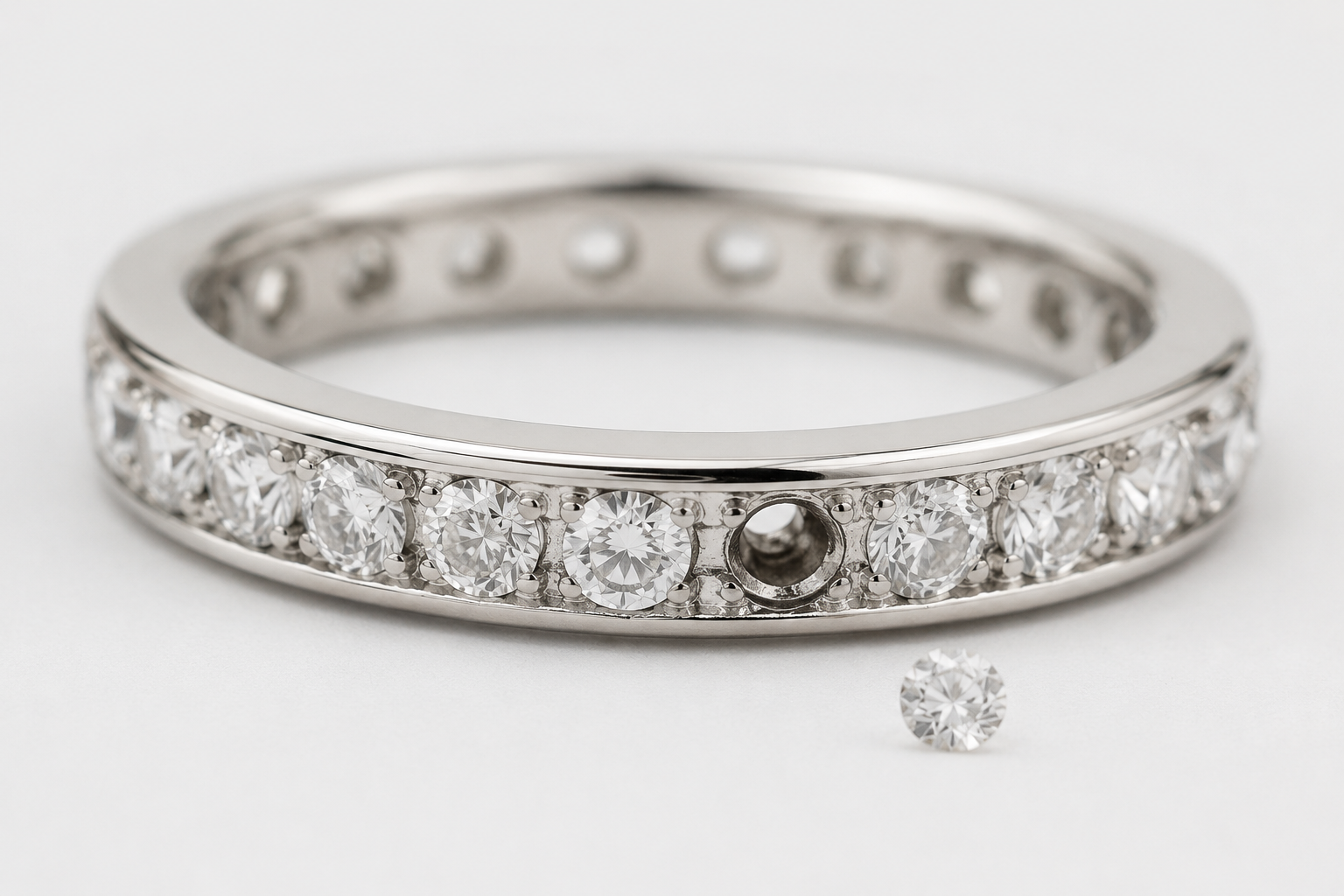
Why Small Diamonds Fall Out of Eternity Rings More Often
Small diamonds fall out of eternity rings more often because the stones are held by very small amounts of metal in a ring style that is exposed to constant hand contact. An eternity ring is beautiful because it places many small diamonds around the finger, but that same design creates more setting points, more tiny claws, more edges that can catch, and more surfaces that experience knocks during daily wear. This guide explains why losses happen, how full and half eternity designs differ, why servicing matters, what warranty assessments usually consider, and how OgilvieGems helps clients choose settings that balance sparkle with realistic durability.
Why eternity rings lose small diamonds more often
Eternity rings use many small diamonds instead of one central stone, so the ring has many more individual setting points that can wear, bend or loosen over time. A single engagement ring may rely on a few substantial claws around one diamond, while an eternity ring can have dozens of tiny claws or beads holding numerous stones. The diamonds themselves are usually not the problem; the risk comes from scale, daily impact, repeated friction and the fact that fine metal work has less reserve strength than larger settings.
More stones means more possible failure points
Each small diamond has its own contact points with the ring. If one tiny claw wears down, lifts or is caught by fabric, that individual stone can become vulnerable even when the rest of the ring looks perfect.
Small claws have limited metal mass
The claws on fine eternity rings are deliberately small so the diamonds remain visible. That gives the ring its sparkle, but it also means there is less metal protecting each stone from knocks and long-term wear.
The ring sits in an active area of the hand
Eternity rings are worn on fingers that grip steering wheels, gym equipment, handbags, phones, kitchen tools and door handles. Those everyday contacts create side pressure that can slowly affect tiny settings.
Loss is not always caused by one dramatic event
A diamond may fall out after a minor catch because the claw was already worn or slightly lifted. The final moment may look small, but the underlying cause is often cumulative wear.
The visual style that creates the risk
Eternity rings are loved because they create a continuous line of sparkle across the finger. To achieve that delicate look, jewellers often use shared claws, micro pavé, bead settings or fine channels that expose as much diamond as possible. The more refined and diamond-forward the design, the less visible metal there is, which is why visual lightness and long-term durability must be balanced carefully.
Delicate styles show more diamond
A fine eternity ring can look elegant because the diamonds appear to float around the finger. That effect is created by reducing visible metal, but reduced metal also means less protection around each stone.
Shared claws create efficient sparkle
In shared-claw designs, one small claw may help secure more than one diamond. This keeps the band refined, but if the shared point wears or bends, more than one setting area can be affected.
Fabric catches are a real concern
Tiny claws can catch on knitwear, towels, gloves, bedding or hair. A single catch may not remove a stone immediately, but repeated catching can lift claws and gradually reduce stone security.
How diamond size, band width and proportions affect security
The proportions of an eternity ring determine how much metal can realistically support the diamonds. If the diamonds are large for the band, the setting may become visually impressive but structurally delicate. If the band is too thin, there may not be enough depth or width for secure seating. This is why a responsible design discussion includes not only diamond size, but also finger size, band profile, setting depth and how the ring will be worn.
Very small stones still need accurate seats
Even tiny diamonds need precisely cut seats in the metal. If a seat is too shallow, worn or distorted, the diamond can move, and movement is often the first stage before loss.
A narrow band leaves less room for strength
A slim eternity ring may look graceful, but there is less metal to absorb impact. When the band is extremely fine, the setting can become more sensitive to knocks, bending and long-term wear.
Bigger sparkle is not always the safer choice
Increasing diamond size without increasing band structure can create a top-heavy design. The stones may look impressive, but the metal holding them may be working at its limit.
Fancy centre-stone proportions can affect pairing
If an eternity ring is worn beside a pear or teardrop engagement ring, the centre stone’s length-to-width ratio, pointed tip and V-prong can influence where the bands touch. Those contact points should be checked so the eternity ring is not rubbed in one concentrated area.
Why maximum brilliance can reduce protective metal
A sparkling eternity ring depends on light entering and returning through many small diamonds. To maximise brilliance, settings often expose the tops and sides of the stones instead of surrounding them with heavy metal. That open, bright look is desirable, but it also means the diamonds are more exposed to side impact than stones set in deeper or more protective designs.
Open settings allow more light
Open sides and fine claws help small diamonds look brighter. The trade-off is that exposed stone edges and tiny claws can take more direct contact during daily wear.
Low metal visibility changes risk
When metal is minimised, the ring looks more diamond-rich. However, every reduction in visible metal must still leave enough structure to hold stones securely over time.
Brilliance terms can be misunderstood
Terms such as bow-tie are usually discussed with elongated fancy diamonds, including some pear or teardrop centre stones. They do not explain why small eternity diamonds fall out, but they show why cut, shape and design details should not be treated as decoration only.
The main durability warning: tiny settings need regular inspection
Small diamonds in eternity rings are not held by large, heavy claws. They are held by precise, miniature metal work that can wear down from friction, bend from knocks, catch on fabric and loosen from repeated pressure. A ring can look normal to the eye while one claw is already thin or lifted under magnification. Regular inspection is the safest way to catch issues before a diamond is lost, and warranty assessments usually consider wear patterns, impact marks, missing metal, service history and how the ring has been used.
Which eternity ring settings are more sensitive?
No eternity setting is completely immune to stone loss, but some designs are more exposed than others. Micro pavé and shared-claw rings can deliver exceptional sparkle with minimal metal, while channel and bar styles may offer more protection in certain areas. The right choice depends on how refined you want the ring to look, how often you will wear it, whether you stack it, and how much maintenance you are comfortable with.
At OgilvieGems, the design conversation is not only about the prettiest ring in a display image. We consider claw size, diamond spacing, band depth, metal choice, finger size and lifestyle so the finished ring is beautiful and realistic for everyday wear.
Custom Design ProcessShared claw settings
Shared claws create a delicate, continuous diamond line. They need careful manufacturing and regular checks because a small amount of metal may help secure adjacent stones.
Micro pavé settings
Micro pavé gives a glittering surface, but the beads are tiny. These rings are especially sensitive to fabric catches, knocks and wear from stacking.
Channel settings
Channel settings protect the stones along the edges with continuous metal walls. They can be more practical for some wearers, although they still need inspection for bending, wear and trapped dirt.
Bead and bright-cut settings
Bead-set eternity rings can look refined and elegant. Their security depends on the quality of each bead, the depth of the setting and how the ring is maintained.
How direction, stacking and neighbouring rings create pressure points
An eternity ring does not live in isolation on the hand. It may be worn beside an engagement ring, a wedding band or another stack ring, and those neighbouring rings can rub, knock or press against its settings. Direction matters most when a nearby ring has a raised centre stone, a protruding basket, a pointed tip or a protective feature such as a V-prong that touches the eternity band during movement.
Point direction can concentrate contact
A pear or teardrop centre stone has a clear point direction. If the pointed tip faces an eternity ring, the V-prong or tip area may sit close to the band and should be checked for rubbing.
Stacking can wear claws from the side
When rings rub together every day, the side of one ring can file against the tiny claws of another. This is a common reason eternity rings need maintenance even when the wearer has not noticed a major knock.
Different ring heights can cause impact
A low eternity band beside a high engagement ring can receive repeated side contact from the higher ring’s setting. Small repeated impacts can be more damaging than they appear.
Spacing can improve long-term wear
A small design adjustment, spacer band or better-matched profile can reduce concentrated rubbing. The goal is not to make the stack bulky, but to prevent one ring from damaging another.
How metal choice affects tiny claws and long-term wear
Metal choice matters because the diamonds in an eternity ring rely on very small pieces of metal for security. Platinum, white gold, yellow gold and rose gold each behave differently under wear. The best choice depends on the design, the wearer’s habits, the desired colour, maintenance expectations and whether the ring will be worn daily or mainly for special occasions.
Platinum
Platinum is dense and often preferred for fine diamond settings. It can still wear, bend or deform under pressure, but it tends to displace rather than disappear as quickly as some softer wear patterns.
White gold
White gold can be an excellent choice, but it usually needs rhodium maintenance to keep its bright white finish. Claws should be inspected during plating appointments so cosmetic servicing also supports stone security.
Yellow gold
Yellow gold offers a warm look and can make small diamonds stand out beautifully. The alloy and setting style should be chosen carefully for claws that are fine but not underbuilt.
Rose gold
Rose gold has a distinctive colour and can suit vintage-inspired eternity rings. Its behaviour depends on the alloy and design, so very delicate settings should be assessed for practical wear before purchase.
Lab-grown or mined diamonds: does origin affect stone loss?
Whether the small diamonds are lab-grown or mined is usually not the reason they fall out. Diamond origin does not change the fact that the stones need accurate seats, secure claws and a ring structure that can handle daily wear. For eternity rings, the bigger questions are setting quality, metal strength, diamond matching, maintenance history and how the ring is worn.
Origin is not the main security factor
Lab-grown and mined diamonds can both be securely set when the ring is made well. Stone loss is far more often linked to setting wear, impact, bending or insufficient maintenance.
Small diamonds should still be matched
Well-matched small diamonds create a cleaner visual line. Matching size and cut consistency also helps the jeweller set the stones evenly, which can support better long-term performance.
Value changes the repair conversation
Replacing a small lab-grown or mined diamond may be less costly than replacing a large centre stone, but the repair still requires skilled labour, setting assessment and sometimes rebuilding worn metal.
Common mistakes that make small diamonds more likely to loosen
Many eternity ring problems are preventable, but prevention requires realistic expectations. A fine diamond band is jewellery, not protective equipment. It can be worn and enjoyed, but it should be treated as a precise setting with many small parts. The most common mistakes are not about carelessness; they usually come from not knowing how sensitive miniature settings can be.
Wearing the ring during high-impact tasks
Gym training, lifting heavy objects, gardening, cleaning, DIY work and carrying hard items can place pressure on the band and settings. Removing the ring for these activities reduces risk.
Ignoring small catches
If a ring suddenly catches on clothing or hair, a claw may be lifted. Continuing to wear it without inspection can turn a small repair into a missing-stone repair.
Skipping servicing
An eternity ring should be checked periodically under magnification. Servicing can identify thinning claws, movement, worn beads and contact wear before a diamond falls out.
Assuming every loss is automatically covered
Warranty outcomes depend on the circumstances. Manufacturing concerns, impact damage, wear, bending, missing metal and service history are assessed individually rather than assumed from the fact that a stone is missing.
How to buy an eternity ring with fewer surprises
The best eternity ring is one that suits how you actually live. If you want a ring for daily wear, the design should allow enough metal support, sensible diamond size and a maintenance plan. If you want the most delicate possible appearance, you should understand that it may require more careful wearing and more frequent inspections. OgilvieGems helps clients choose the right compromise before the ring is made.
Choose the right coverage
A half eternity ring often places diamonds only across the visible top of the finger, leaving more plain metal underneath. A full eternity ring gives sparkle all the way around but exposes diamonds and settings to more palm-side wear.
Ask about maintenance before buying
A good eternity ring conversation should include cleaning, claw checks, polishing limits, rhodium plating if relevant and what to do if a claw catches.
Match the ring to your stack
Bring or describe the rings you plan to wear with it. The profile of an engagement ring or wedding band can affect where an eternity ring rubs and how quickly small claws wear.
Prioritise realistic durability
A slightly stronger setting can still look elegant. Choosing enough metal, suitable diamonds and a practical profile is often better than choosing the thinnest possible band.
Why Small Diamonds Fall Out of Eternity Rings More Often FAQ
Why do small diamonds fall out of eternity rings more often than larger centre stones?
Eternity rings contain many small diamonds, each held by tiny claws, beads or channels. Because there are more setting points and less metal around each stone, there are more places where wear, impact or fabric catches can create a problem.
Is a missing small diamond always a manufacturing fault?
No. A missing stone must be assessed. Manufacturing issues are possible, but so are impact damage, worn claws, bending, ring stacking wear, fabric catches and lack of servicing. Each case is reviewed according to the evidence on the ring.
Are full eternity rings more likely to lose diamonds than half eternity rings?
Full eternity rings can be more exposed because diamonds and settings continue around the underside of the finger, where the ring contacts hard surfaces more often. Half eternity rings usually protect the palm side with plain metal, which can make them more practical for daily wear.
What should I do if my eternity ring catches on clothing?
Stop wearing it until it can be checked. A catch may mean a claw has lifted. Continuing to wear the ring can allow the diamond to move and may increase the chance of losing the stone.
How often should an eternity ring be serviced?
For daily wear, inspection at least once or twice a year is sensible, and sooner if the ring catches, is knocked, feels rough, or is worn in a stack. The right interval depends on the setting, metal and lifestyle.
Does platinum prevent small diamonds from falling out?
Platinum can be an excellent metal for fine diamond settings, but it does not make a ring indestructible. Tiny platinum claws can still bend, wear or loosen after impact or long-term friction.
Can I wear an eternity ring next to my engagement ring every day?
Often yes, but the two rings should be checked for rubbing. Raised settings, pear or teardrop centre stones, pointed tip areas and V-prong details can create contact points that may wear an eternity band over time.
Are lab-grown diamonds more likely to fall out of eternity rings?
No. Lab-grown diamond origin is not the usual cause of stone loss. The important factors are setting design, metal condition, manufacturing quality, impact exposure and maintenance.
Can a lost small diamond be replaced?
Usually yes, but the jeweller must inspect the setting first. If the claws or seat are worn, the metal may need rebuilding before a replacement diamond is fitted securely.
Design an eternity ring that balances sparkle with real-life wear
If you want an eternity ring for daily wear, OgilvieGems can help you compare half and full eternity styles, setting options, metal choices and maintenance expectations before you commit.
Request A Custom Quote