 Custom
Quote
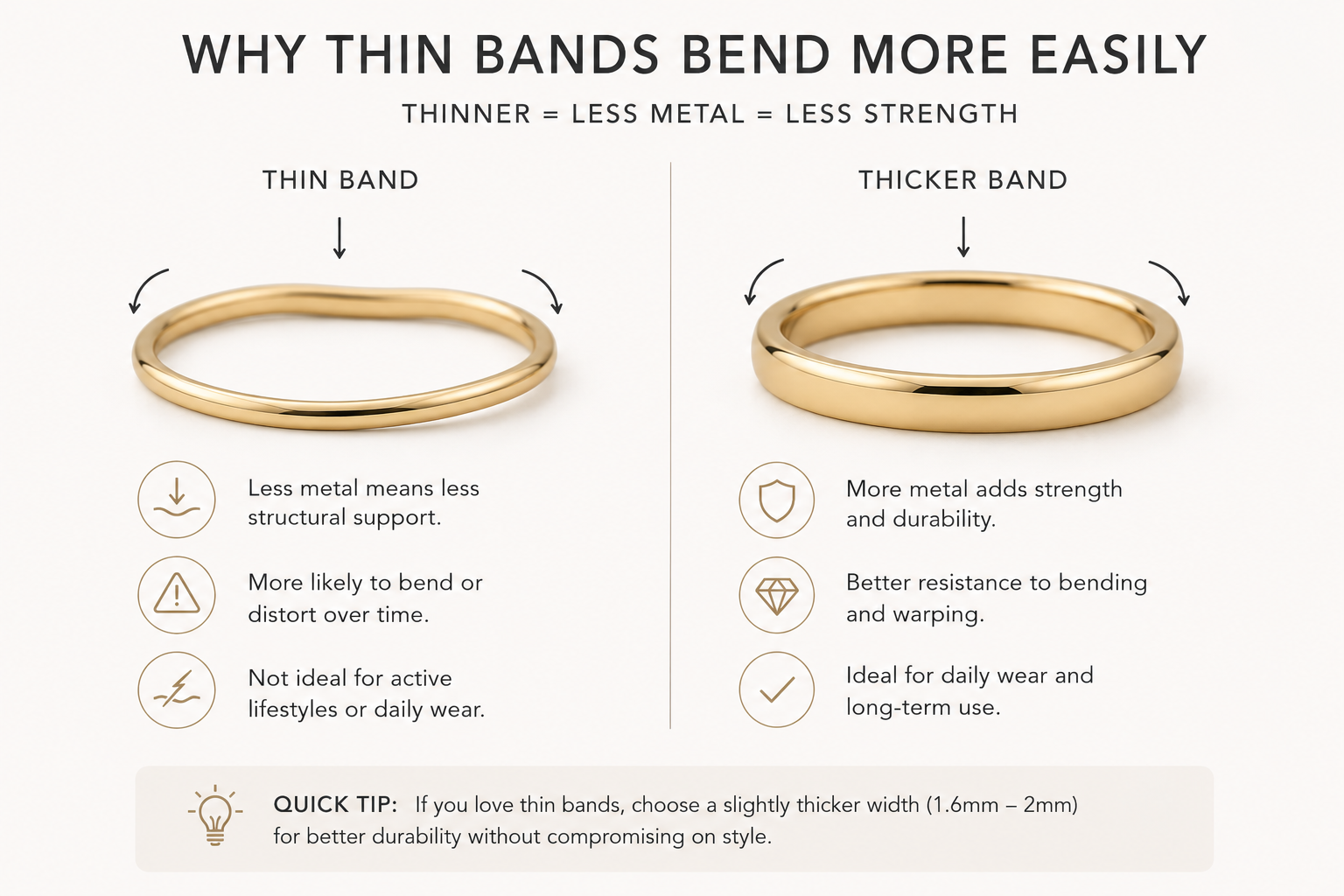
Why Thin Bands Bend More Easily
Thin engagement ring bands bend more easily because there is less metal resisting pressure, twisting and repeated daily impact. A slim band can be beautiful, elegant and perfectly suitable when it is designed with the right width, depth, metal, setting and wearer expectations. The risk is not simply that a band looks delicate; it is how much structural metal sits under the finger, how high the centre stone is set, where pressure concentrates, and whether daily wear includes lifting, gripping, gym work, childcare, gardening or hands-on work.
Why thin bands are more vulnerable to bending
A ring band works like a small structural beam around your finger. When the band is very narrow or shallow, there is less metal to resist pressure from door handles, gym equipment, steering wheels, shopping bags, luggage, desk edges and everyday gripping. This does not mean every fine band is poorly made. It means delicate proportions need smarter engineering, realistic wear habits and a setting that does not overload a thin shank.
Width is only one part of strength
A 1.6 mm band and a 2.0 mm band may look similar from above, but the extra width can make a meaningful difference to resistance against sideways pressure. The visible top view matters aesthetically, while the metal profile beneath the finger matters structurally.
Thickness is just as important
A band that is narrow and shallow is more likely to deform than a band that is narrow but properly built in depth. Many bending issues happen because the shank has been made too low in profile to create an ultra-fine look.
Pressure concentrates at weak points
The base of the band, the shoulders beside the centre setting, sizing joins and areas with tiny stones can become stress points. If the ring receives force in the same area repeatedly, the metal can gradually move out of round.
Design and lifestyle work together
A delicate band worn mostly for office, social and occasional daily use may perform well. The same band worn during lifting, cleaning, exercise or hands-on work has a higher chance of bending because it is exposed to stronger leverage and impact.
The visual appeal of thin bands
Thin engagement ring bands remain popular because they create a refined, modern look and make the centre stone feel visually larger. They are often chosen for solitaire rings, oval-inspired layouts, round brilliant settings and pear or teardrop designs where the wearer wants the diamond to be the focus rather than the metal.
They make the centre stone stand out
A slimmer shank gives the eye less metal to notice, which can make the diamond appear more prominent. This is one reason delicate bands are often requested with higher-colour diamonds, elongated stones and minimalist settings.
They suit fine, feminine styling
Many clients love the soft, understated appearance of a thin band. The goal is not to avoid delicate jewellery entirely, but to keep the design fine without removing so much metal that the ring loses practical strength.
They pair well with stacking bands
A thin engagement ring can sit neatly beside a wedding band or anniversary band. However, stacking adds contact points, so the rings should be designed to minimise rubbing, thinning and pressure between the bands.
Band width, thickness and proportions
A band can be visually slim while still being more durable if the proportions are managed correctly. The important question is not only how many millimetres wide the ring appears from the top, but how much structural metal is present through the depth of the shank and how the band transitions into the setting.
Very narrow bands have less resistance
As band width decreases, the shank has less surface area to resist bending. A fine band may still be suitable, but it should not be treated like a heavy everyday ring if the wearer is active with their hands.
Low-profile bands can flatten faster
A thin top view combined with a very shallow side profile creates a band that can lose roundness more easily. A comfort fit profile can help, but it must still leave enough metal for strength.
Shoulder design affects performance
The shoulders are where the band approaches the centre stone. If the shoulders taper too aggressively, the ring may be elegant but less able to resist twisting around the setting.
Stone proportions can influence band choice
An elongated diamond with a higher length-to-width ratio, such as a pear or teardrop centre stone, can create more finger coverage. The band should be proportioned to support that visual length without looking heavy or feeling underbuilt.
How the centre stone affects the band
The diamond or gemstone does not bend the band by itself, but its size, shape, height and setting style influence how force moves through the ring. Larger stones, higher settings and elongated silhouettes can increase leverage, especially when paired with very fine shanks.
Larger stones create more leverage
A tall centre setting can act like a lever when it is knocked from the side. On a thin band, that leverage may twist the shoulders or pull the shank slightly out of alignment over time.
Pear and teardrop stones need thoughtful support
A pear-shaped diamond has a rounded end and a pointed tip, so the setting must secure both shape features properly. A V-prong is commonly used at the pointed tip to protect the vulnerable end while keeping the teardrop outline visible.
Cut appearance still matters
When selecting an elongated centre stone, the length-to-width ratio affects presence, balance and how fine the band appears beside it. The bow-tie effect can also influence how lively the stone looks, so the diamond should be assessed visually rather than only by measurements.
Thin bands are not defective by default, but they have lower tolerance for force
A delicate engagement ring can be beautifully made and still bend if it is exposed to repeated pressure beyond what its structure is designed to handle. Common causes include gripping weights, carrying heavy bags, pushing prams, moving furniture, gardening, sleeping with the ring on, or wearing it during tasks that compress the band against a hard object. The practical expectation is simple: the finer the band, the more mindful the wear should be.
Setting design can protect or weaken a fine band
A thin band needs a setting that distributes force well. The strongest designs do not rely only on a tiny peg or a narrow connection point beneath the centre stone. They use well-shaped shoulders, secure claws, balanced height and enough metal around stress areas to keep the ring stable.
For pear and teardrop centre stones, the direction of the point, the V-prong at the pointed tip and the way the shoulders meet the head all affect both beauty and durability. A fine shank can work, but it should be designed as a complete structure rather than as a thin band with a heavy setting added on top.
Custom Design ProcessCathedral shoulders add support
Cathedral shoulders rise toward the centre stone, creating extra support and a smoother transition from band to setting. This can help a fine ring feel more stable without making the design look bulky.
Pave bands need extra caution
Tiny diamonds set into a slim band require small holes and claws, which reduce uninterrupted metal. A pave band can still be made well, but it should not be made too narrow for the stone size and daily wear expectations.
Hidden halos add complexity
A hidden halo can add sparkle below the centre stone, but it also raises the importance of cleaning, claw checks and structural balance. On a very thin band, the setting must be engineered carefully.
Point direction and shape orientation
Some centre stone shapes are directional, and that direction changes the visual flow of the ring. A pear or teardrop diamond can be worn with the point direction facing toward the fingertip or toward the hand. This choice is mainly aesthetic, but it also affects how the setting is perceived and where protective details must be placed.
Point toward the fingertip
When a pear diamond points toward the fingertip, the ring often looks elongated and elegant. The pointed tip should be protected with a secure V-prong, especially if the band is slim and the stone sits high.
Point toward the hand
When the point direction faces the hand, the design can feel softer and more contemporary. The same structural rules apply: the pointed tip must be protected and the setting must not overload the fine shank.
Orientation affects balance
A directional stone can visually pull the eye along the finger. If the band is very thin, the jeweller must balance visual delicacy with enough shoulder support so the ring does not feel top-heavy.
Metal choice and bending resistance
Metal choice has a major effect on how a thin band wears. Different metals have different hardness, toughness, spring, maintenance needs and repair behaviour. The best metal is not always the hardest one; it is the one that suits the design, the wearer and the long-term service plan.
Platinum is dense and durable
Platinum is valued for its density, toughness and long-term wear properties. It can be an excellent choice for fine engagement rings, although a very thin platinum band can still bend if it is exposed to enough force.
Gold alloys vary by colour and karat
White gold, yellow gold and rose gold behave differently depending on alloy and karat. Higher purity gold can be softer, while alloy composition influences strength, colour and maintenance.
Rose gold can feel firm but is not indestructible
Rose gold often contains copper, which can make it feel relatively firm in wear. Even so, a very narrow rose gold band can still deform if the shank is too light or the wearer is hard on jewellery.
Metal cannot compensate for poor proportions
Choosing a strong metal helps, but it does not remove the need for adequate width, thickness and support. A thin band must be designed correctly regardless of metal.
Lab-grown and mined diamonds on thin bands
Whether the centre diamond is lab-grown or mined does not change the physics of the band. Both can be set securely in fine jewellery when the ring is designed well. The more relevant questions are the stone size, setting height, shape, budget allocation and how much metal remains in the band.
Bigger stone budgets can change the structure
Lab-grown diamonds can make larger centre stones more accessible. If the centre stone size increases, the ring may need a slightly stronger band or more supportive shoulders to handle the extra visual and physical presence.
Mined diamonds need the same engineering
A mined diamond does not require a different band structure purely because of its origin. The setting still needs secure claws, appropriate height and enough shank strength for everyday wear.
Spend should include the ring body
It is tempting to maximise diamond size and minimise the band, but the ring body is what carries the stone every day. A balanced budget should protect both beauty and longevity.
Common mistakes that make thin bands bend sooner
Many bending problems are preventable when the ring is designed and worn with realistic expectations. The most common issue is not choosing a slim band; it is combining multiple delicate choices in one ring without enough structural planning.
Choosing the thinnest possible shank
Ultra-fine bands may look beautiful in photos but can be less practical for constant wear. A small increase in width or depth can often preserve the delicate look while improving strength.
Setting a heavy centre too high
A high centre stone can catch more easily and place more leverage on the shoulders. A balanced height can improve wearability while still allowing light and elegance.
Ignoring ring size changes
Large resizing adjustments can affect the roundness and strength of a fine band. If finger size fluctuates, the design should allow for practical future maintenance.
Wearing the ring for every activity
Engagement rings are made for regular wear, but not every task is ring-friendly. Removing a thin band during heavy, abrasive or compressive activities can significantly reduce bending and stone-setting problems.
How to buy a thin band wisely
A well-designed thin band should be chosen with both the eye and the lifestyle in mind. The best result is a ring that looks delicate from a normal viewing distance but still has enough structure to support the centre stone, handle reasonable wear and be maintained over time.
Ask about both width and depth
Do not only ask how wide the band is. Ask about the side profile, the thickness at the base, the shoulders and whether the ring has enough metal for future polishing and maintenance.
Match the band to the wearer
A client who types, attends meetings and removes jewellery for exercise may suit a finer band than someone who works with tools, lifts weights or handles equipment daily.
Check the setting before committing
Look at how the centre stone is supported, not only how it appears from above. For pear or teardrop designs, confirm that the pointed tip is protected by a V-prong and that the stone is not sitting insecurely on a fragile connection.
Plan maintenance from the start
Fine rings benefit from periodic checks for roundness, claw security, pave movement and wear between stacked bands. Regular maintenance is part of owning a delicate engagement ring responsibly.
Why Thin Bands Bend More Easily FAQ
Why do thin engagement ring bands bend more easily?
They contain less metal to resist pressure, twisting and impact. When a band is very narrow or shallow, everyday force is concentrated into a smaller structure, making it easier for the ring to move out of round.
Does a bent thin band mean the ring was badly made?
Not always. A well-made delicate ring can bend if it is worn during heavy gripping, lifting, gym training, gardening or other activities that compress the band. Craftsmanship matters, but lifestyle and design limits matter too.
What band width is safest for everyday wear?
There is no single perfect width, because thickness, metal, setting style and lifestyle all affect durability. As a general rule, extremely fine bands need more care, while a slightly wider and deeper shank usually offers better everyday strength.
Is platinum better than gold for a thin band?
Platinum is dense and tough, which can make it a strong option for fine engagement rings. However, platinum is not immune to bending. Proper proportions and sensible wear are still essential.
Can I have a pear or teardrop diamond on a thin band?
Yes, but the setting should be designed carefully. A pear or teardrop centre stone needs secure support, and the pointed tip should usually be protected with a V-prong. The band should also be strong enough for the stone size and setting height.
Does point direction affect durability?
Point direction is mostly a style choice, but it changes how the ring looks and how the setting is arranged. Whether the point faces the fingertip or the hand, the pointed tip must be protected and the shoulders should support the centre setting properly.
Do lab-grown diamonds make thin bands more likely to bend?
The diamond origin does not affect band strength. However, because lab-grown diamonds can allow clients to choose larger stones within budget, the ring may need stronger proportions to support the larger centre stone.
Can a bent thin band be repaired?
In many cases, a jeweller can round and assess the band, check the setting and tighten stones if needed. If bending happens repeatedly, the ring may need a stronger shank, design adjustment or different wear habits.
How can I reduce the chance of my thin band bending?
Remove the ring for gym work, heavy lifting, cleaning, gardening and tasks that press the band against hard surfaces. Choose a ring with adequate thickness, supportive shoulders, secure setting details and a metal suited to your lifestyle.
Design a thin band that suits real life
If you love the delicate look, OgilvieGems can help you balance fine proportions with practical structure, secure stone setting and a metal choice that suits how you wear your jewellery.
Request A Custom Quote