 Custom
Quote
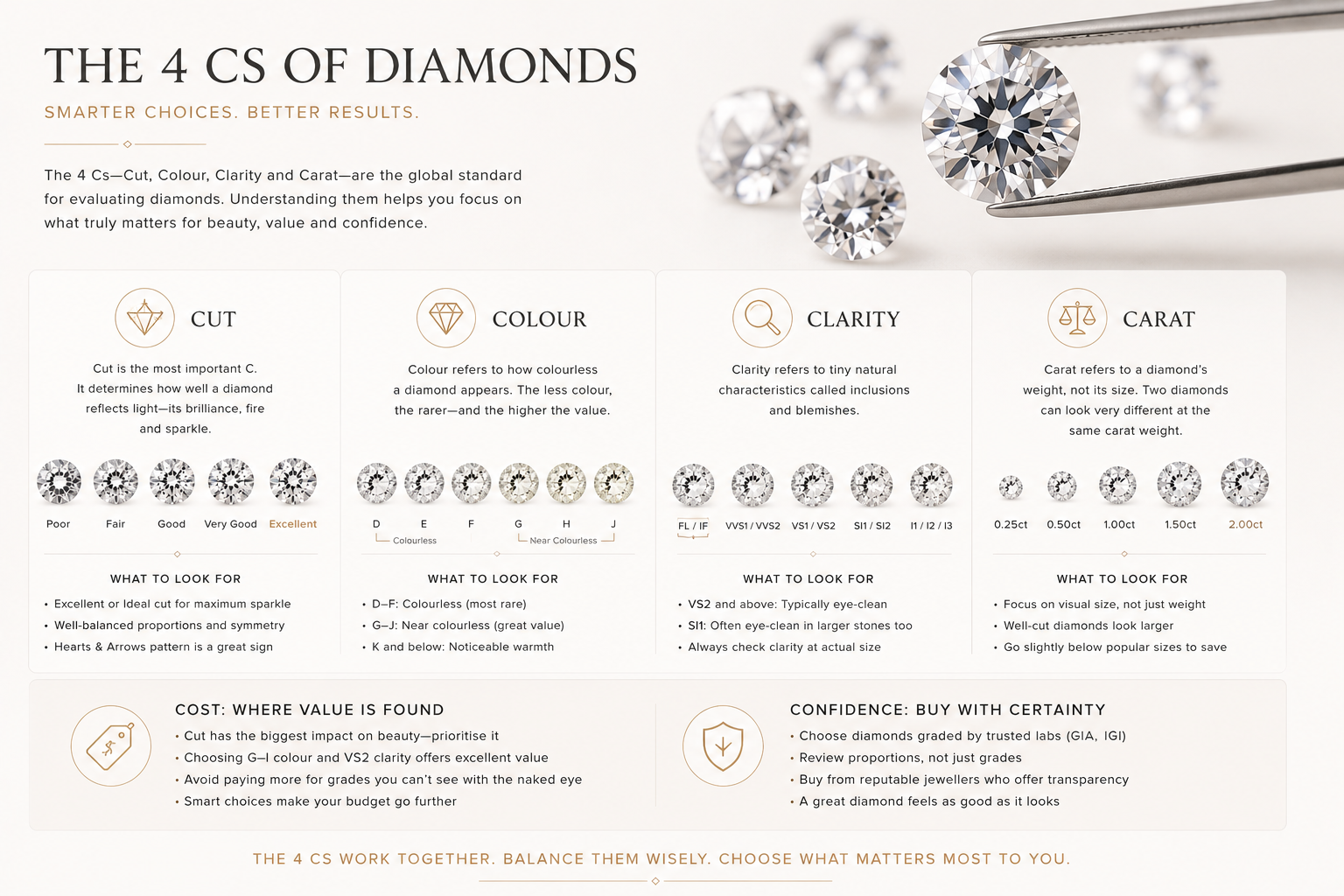
Cut, colour, clarity, carat — plus cost and confidence.
The 4 Cs help compare diamonds, but they do not automatically tell you which diamond is best for your ring. OgilvieGems also adds two practical Cs: cost and confidence, because the right diamond must suit the design, the budget and the person wearing it.
The 4 Cs are useful. They are not the full decision.
Cut, colour, clarity and carat help describe a diamond. Cost and confidence help decide whether that diamond actually makes sense for the client, the design and the budget.
Cut
Cut affects sparkle, brightness, fire, contrast and how alive the diamond looks.
Colour
Colour affects how white or warm the diamond appears once it is set.
Clarity
Clarity is about internal and external marks. The practical question is whether the diamond looks clean to the eye.
Carat
Carat is weight, not automatic visual size. Shape, spread and depth affect how large the diamond appears.
Cost
Cost is OgilvieGems’ practical fifth C. It keeps the diamond decision realistic within the full ring budget.
Confidence
Confidence is OgilvieGems’ sixth C. It means understanding what you are buying and why it suits the ring.
Cut is where sparkle lives.
Cut is not only the shape of the diamond. It is how well the diamond handles light.
A diamond with poor light performance can look lifeless even if the colour and clarity look good on paper.
Explore Diamond ShapesBrightness
A well-cut diamond returns more light and looks more alive.
Fire
Fire refers to coloured flashes of light. It is part of what gives a diamond personality.
Proportion
Depth, table, symmetry and polish affect how the diamond performs visually.
Colour is about how white or warm the diamond appears.
Colour grade matters, but context matters too. A diamond can look different depending on metal colour, stone shape, size and lighting.
White metals
White gold and platinum can make warmth easier to notice, especially in larger stones.
Yellow and rose gold
Warmer metals can make slightly warmer diamonds feel intentional and beautiful.
Shape matters
Some shapes show colour more clearly than others, especially in larger sizes.
Clarity should be judged with the eye, not only the grade.
Clarity describes inclusions and surface features. The practical question is whether anything is visible and whether it affects beauty, structure or confidence.
Eye-clean matters
A diamond can be a smart choice when it looks clean to the eye, even if the paper grade is not the highest.
Emerald cuts show more
Step cuts can reveal clarity more easily than brilliant cuts, so clarity standards may need to be stricter.
Do not overpay blindly
Paying for clarity that does not improve the visible ring may not be the best use of budget.
Carat is weight, not automatic size.
Two diamonds with the same carat weight can look different on the hand. Measurements, shape, depth and setting style can change the visual presence.
Face-up size
Oval, pear, marquise and some elongated shapes can look larger face-up than deeper stones of similar weight.
Depth matters
Some diamonds carry weight in depth rather than visible spread, which can affect perceived size.
Balance matters
The best carat choice should suit the hand, setting, budget and overall design.
OgilvieGems adds two practical Cs: cost and confidence.
Cost keeps the diamond decision realistic. Confidence makes sure the client understands the diamond, the trade-offs, the certification, the design and the reason behind the choice.
Cost does not mean choosing the cheapest diamond.
Cost means using the budget wisely. Sometimes that means choosing a slightly smaller diamond with better cut. Sometimes it means choosing lab-grown for size flexibility. Sometimes it means spending more on setting quality instead of chasing paper specifications.
Design budget
The diamond should leave enough room for the ring to be made properly.
Stone budget
The stone should be selected around visible beauty, not just the highest grade on paper.
Long-term budget
Maintenance, setting style and wearability should be considered before finalising the design.
Confidence is the C that protects the buyer.
Confidence means knowing what the diamond is, what it is not, why it suits the ring and whether the trade-offs make sense.
This is where proper guidance matters more than generic diamond charts.
Certification GuideOrigin confidence
Know whether the diamond is lab-grown or mined.
Specification confidence
Understand cut, colour, clarity, carat and how those details affect the ring.
Design confidence
Know that the diamond suits the setting, finger size, wedding band fit and long-term wear.
The 4 Cs of Diamonds FAQ
What are the 4 Cs of diamonds?
The traditional 4 Cs are cut, colour, clarity and carat. OgilvieGems also considers cost and confidence because a diamond must make sense visually, financially and personally.
Which C matters most?
Cut is often the most important visual factor because it affects sparkle and light performance, but the best balance depends on the ring design, budget and diamond shape.
Is carat the same as diamond size?
No. Carat is diamond weight. Visual size depends on shape, measurements, depth, spread and setting style.
Does clarity always need to be high?
No. Many diamonds look clean to the eye without needing the highest clarity grade. The right clarity depends on shape, size and visible appearance.
Why does OgilvieGems add cost and confidence?
Cost keeps the decision realistic, while confidence helps the client understand the diamond, the trade-offs, the certificate and the final ring choice.
The best diamond is the one that makes sense in the ring.
The 4 Cs help describe a diamond. Cost and confidence help decide whether it is the right diamond for the person, the design and the moment.
Request A Custom Quote