 Custom
Quote
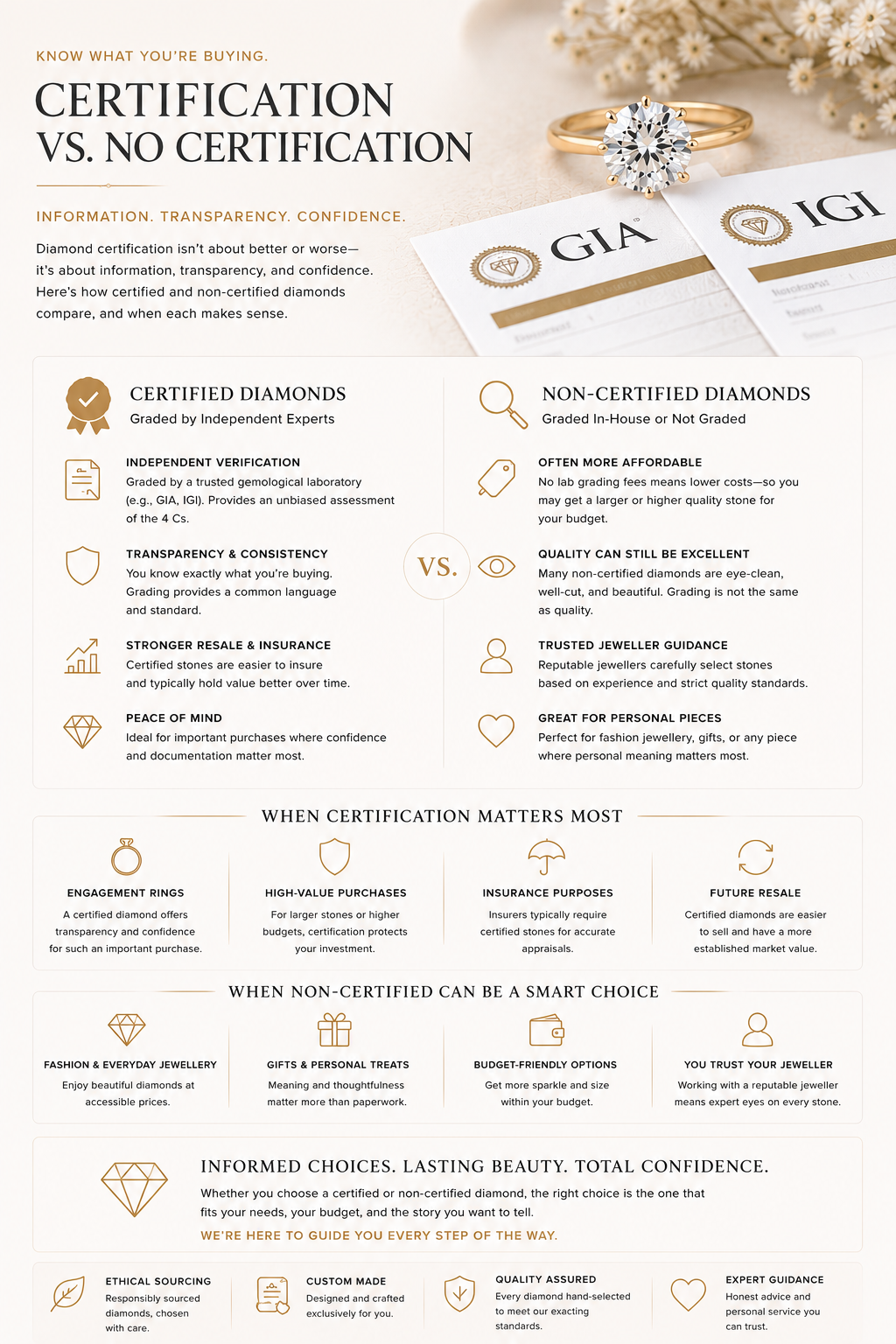
When diamond certification matters — and when it may not.
Certification is about confidence, documentation and independent grading. It does not mean uncertified stones are automatically worthless. The right question is whether a certificate adds meaningful value for the diamond, the budget and the ring.
Certification is useful when proof matters.
A diamond certificate is most valuable when it confirms important details that affect price, confidence or future documentation. For smaller stones, accent diamonds or certain budget-focused pieces, certification may not always be necessary.
It confirms details
A report can confirm carat, colour, clarity, cut and origin information.
It supports confidence
Certification helps the buyer understand what they are purchasing, especially for higher-value stones.
It is not everything
A certificate does not make a poor-looking diamond beautiful, and lack of certification does not make a stone worthless.
When certification matters most.
Certification becomes more important when the diamond is central to the value of the ring or when exact details need independent confirmation.
Large Centre Stones
Certification is usually more important when the diamond is a major centre stone and specifications strongly affect price.
Small Accent Stones
Small side stones and pavé diamonds are often not individually certified because the report can cost more than the practical value it adds.
Lab-Grown Origin
Certification can confirm laboratory origin and separate a lab-grown diamond from a mined diamond.
Insurance Confidence
A certificate can support documentation, valuation context and buyer confidence, especially for higher-value pieces.
Budget Sensitivity
Sometimes money spent on certification may be better used toward cut, setting quality, metal or design if the stone is small.
Resale Expectations
Certification can help with future verification, but it does not guarantee resale value or investment performance.
Uncertified does not automatically mean worthless.
An uncertified stone may still be beautiful, wearable and appropriate. The difference is that the buyer has less independent documentation. That matters more in some purchases than others.
Certification can confirm origin.
For lab-grown diamonds and mined diamonds, certification can clarify whether the stone is laboratory grown or naturally mined.
This is especially important when price, value expectation or client preference depends on origin.
Lab vs MinedLab-grown diamonds
A report can disclose laboratory origin and diamond specifications.
Mined diamonds
A report can disclose natural origin and grading details.
Moissanite is different
Moissanite is not diamond and should not be confused with lab-grown or mined diamonds.
Certification can support documentation, but it is not the whole insurance file.
For higher-value pieces, a certificate may support insurance and valuation context. The finished ring may still need a proper jewellery valuation or invoice documentation depending on the insurer.
Diamond report
Confirms the diamond details where a certified stone is used.
Jewellery valuation
May be needed for the complete ring, including metal, setting, labour and side stones.
Invoice records
Supports proof of purchase and replacement context.
Certification has a cost, so it should add practical value.
On a major centre diamond, certification may be worth it. On very small accent stones, the cost and admin of certification may not make practical sense.
Spend where it matters
Sometimes the budget is better used on cut quality, ring structure or metal choice.
Do not buy paper only
A strong certificate cannot replace visual beauty, good proportions and correct design fit.
Use context
The right answer depends on diamond size, value, origin, design purpose and buyer expectations.
Certification FAQ
Does every diamond need a certificate?
No. Certification is useful when diamond size, value, origin or specifications need independent confirmation, but not every small diamond or side stone needs a full grading report.
Are uncertified diamonds worthless?
No. An uncertified diamond is not automatically worthless. It may still be beautiful and suitable, but the buyer has less independent documentation about exact specifications.
When does certification matter most?
Certification matters most for larger centre stones, higher-value diamonds, lab-grown versus mined origin confirmation, insurance confidence and when exact specifications affect price.
Can lab-grown diamonds be certified?
Yes. Lab-grown diamonds can be certified, and the report should clearly disclose laboratory origin.
Can OgilvieGems help decide whether certification is necessary?
Yes. OgilvieGems can guide clients based on stone size, budget, diamond type, setting purpose and whether independent grading adds meaningful value.
Certification should add confidence, not confusion.
The best diamond decision balances documentation, visual beauty, budget, origin, design and the reason the ring is being made.
Request A Custom Quote