 Custom
Quote
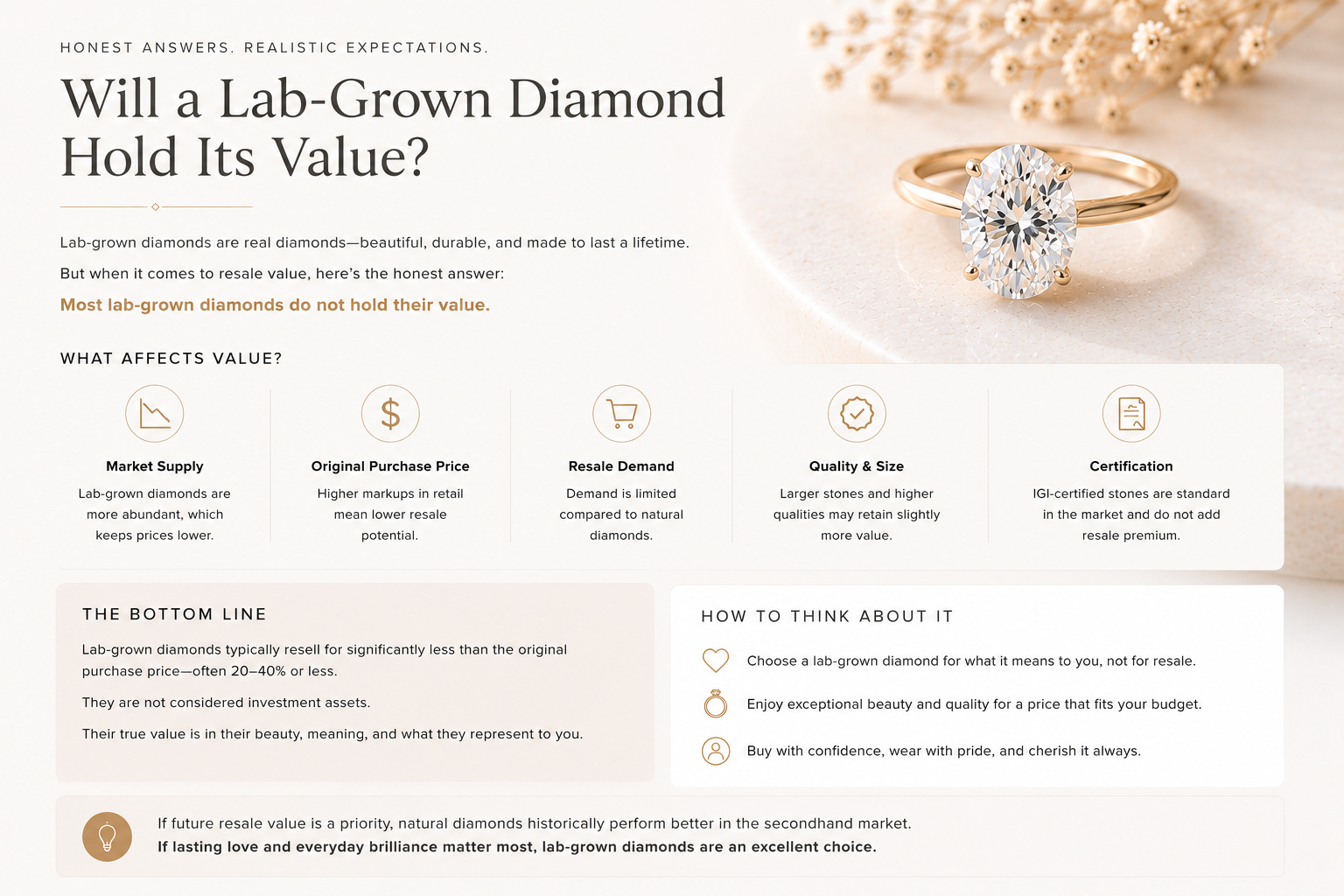
Will a lab-grown diamond hold value?
Usually, a lab-grown diamond should not be bought as an investment asset. It can offer excellent beauty, size and budget value in the finished ring, but resale value is uncertain and often far lower than the retail purchase price.
The honest answer: do not buy lab-grown diamonds for investment.
A lab-grown diamond can be a brilliant choice for a custom engagement ring, but it should be bought for the ring itself — not because you expect the stone to appreciate or resell close to retail value.
Retail price is not resale price
The price paid in a finished jewellery purchase includes sourcing, design, labour, setting, margin, metal and the complete service experience.
The resale market is limited
A private resale buyer may not value the stone the same way a retail buyer values the finished ring.
Value is not only resale
The real value for many clients is beauty, size, meaning, wearability and the proposal moment.
A lab-grown diamond is not a guaranteed resale asset.
This should be said clearly. Lab-grown diamonds can be beautiful and sensible, but they should not be sold as investment products. If resale value is the main concern, the client should understand the market before buying.
Why lab-grown diamond prices can shift.
Lab-grown diamond value is affected by supply, production efficiency, technology, retailer pricing, grading, stone specifications and demand.
Growing supply
As production expands, lab-grown diamond availability can increase, which can put pressure on pricing.
Technology improves
Better production can make certain sizes and specifications easier to obtain over time.
Retail and resale differ
The retail price includes more than the loose stone. Resale usually strips away much of that added context.
Value has more than one meaning.
Lab-grown diamonds often make more sense when value means visual size, beauty, diamond composition and budget flexibility.
They make less sense when the buyer expects investment-like resale performance.
Lab vs MinedVisual value
Lab-grown diamonds can often offer more size or stronger specifications within a given budget.
Emotional value
The meaning of the engagement ring can matter far more than what the loose stone may resell for.
Resale value
Resale should be treated cautiously and should not be the main reason for buying a lab-grown diamond.
What about mined diamonds?
Mined diamonds usually carry stronger traditional market identity and natural-origin perception, but that still does not mean every mined diamond engagement ring is a guaranteed investment.
Traditional identity
Mined diamonds have long-standing cultural and market recognition.
Still not guaranteed
Buying retail and reselling privately are different markets. Investment claims should still be avoided.
Origin preference
Some clients simply prefer natural origin, while others prefer the size flexibility of lab-grown diamonds.
When a lab-grown diamond still makes sense.
A lab-grown diamond can be the right decision when the buyer is clear about why they are choosing it.
You want a real diamond
Lab-grown diamonds are diamonds, not moissanite or imitation stones.
You want more size
Lab-grown options can often allow a larger centre stone within the same budget.
You are buying for meaning
If the ring is being bought for beauty, symbolism and wear, resale may not be the main issue.
Lab-Grown Diamond Value FAQ
Will a lab-grown diamond hold value?
A lab-grown diamond should not be bought as an investment asset. It can hold emotional and design value in the finished ring, but its resale value is usually uncertain and often lower than the original purchase price.
Do lab-grown diamonds have resale value?
Lab-grown diamonds may have some resale value, but the resale market is limited and pricing can be much lower than retail. Buyers should not assume they can resell a lab-grown diamond for close to what they paid.
Why do lab-grown diamonds lose value?
Lab-grown diamond prices can be affected by growing supply, production improvements, retail markups, certification differences and changing market demand.
Are mined diamonds better for resale?
Mined diamonds usually have stronger traditional market recognition, but they are also not guaranteed investment assets. Most engagement rings should be bought for meaning, beauty and wear, not resale profit.
When does a lab-grown diamond still make sense?
A lab-grown diamond can make sense when the client wants a real diamond, larger size, strong visual quality and better budget flexibility, while understanding resale limitations.
Buy lab-grown diamonds for beauty, not investment promises.
A lab-grown diamond can be a smart and beautiful choice when the buyer understands the difference between emotional value, visual value and resale value.
Request A Custom Quote