 Custom
Quote
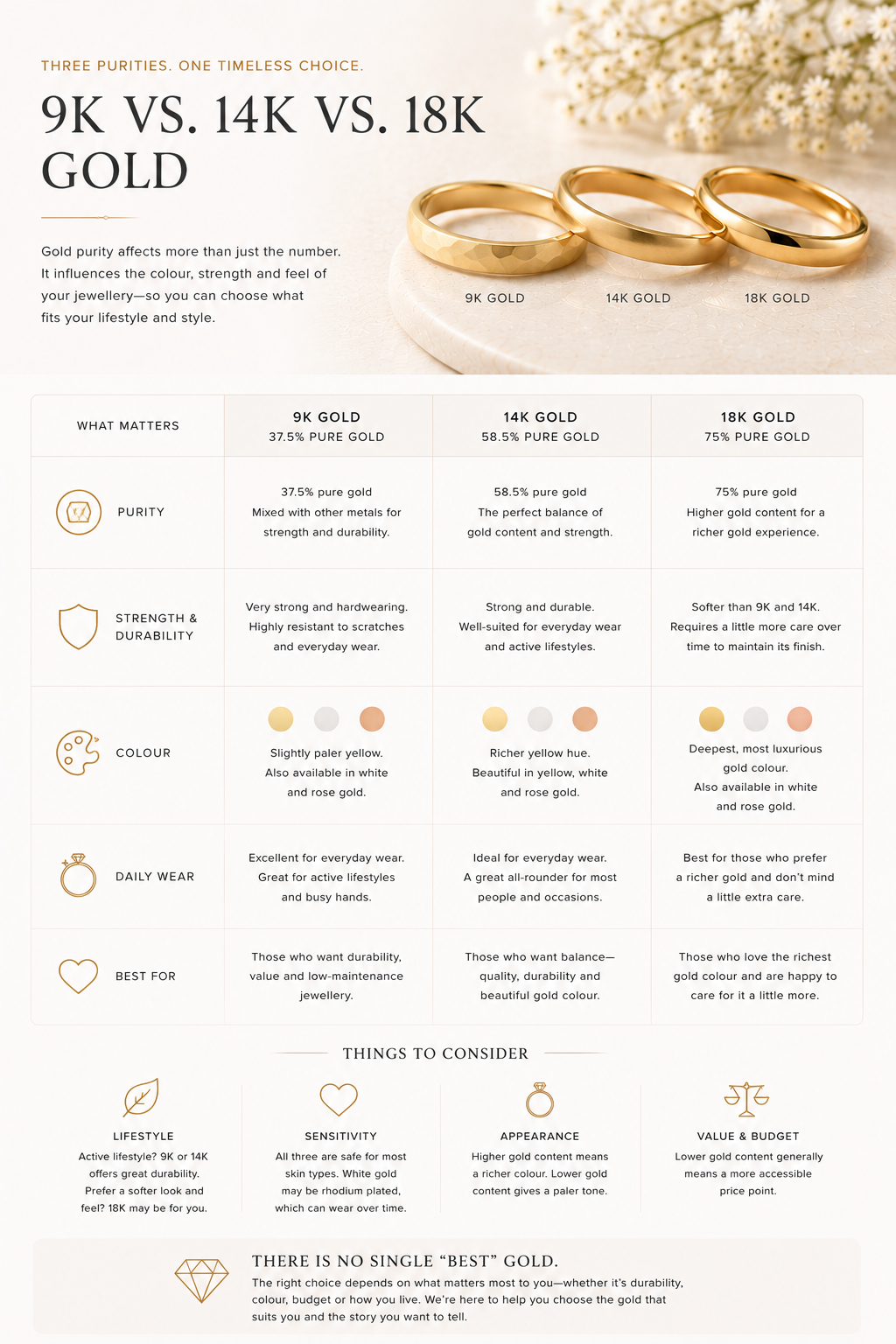
Different gold purities. Different strengths, colours and uses.
9k, 14k and 18k gold are not ranked by one simple winner. 9k can be practical and cost-flexible, 14k often gives a strong daily-wear balance, and 18k gives a richer gold colour and more premium gold content.
9k vs 14k vs 18k gold at a glance.
Gold karat affects purity, colour, price and wear behaviour. The correct choice depends on what the jewellery is, how often it will be worn and what the client values most.
Point
What to compare
9k Gold
Practical and cost-flexible
14k Gold
Balanced daily-wear option
18k Gold
Richer and more premium
Gold Purity
9k gold contains less pure gold and more alloy metals.
14k gold sits in the middle with a balanced gold and alloy mix.
18k gold contains more pure gold and has a richer gold identity.
Strength
9k gold can be practical because the alloy content increases hardness.
14k gold is often a strong daily-wear balance between durability and gold content.
18k gold is luxury and rich, but can feel softer depending on design and wear.
Colour
9k gold usually has a lighter or less rich gold colour.
14k gold has stronger gold warmth than 9k while remaining practical.
18k gold usually has the richest yellow gold colour of the three.
Daily Wear
9k gold can work well for practical jewellery and budget-conscious daily wear.
14k gold is often a strong everyday choice for rings and jewellery.
18k gold is excellent for premium pieces, but design and care matter.
Price
9k gold is usually the most cost-flexible option.
14k gold usually costs more than 9k but less than 18k.
18k gold usually costs more because it contains more pure gold.
Best Fit
Best when budget and practical wear are strong priorities.
Best when the client wants a balanced option.
Best when the client wants a richer, more premium gold choice.
Karat is about gold purity, not automatic quality.
Higher karat means more pure gold content. That can give richer colour and a more premium gold identity, but it does not automatically mean it is the best choice for every ring or every wearer.
Strength depends on purity, alloy and design.
Gold is mixed with other metals to create jewellery alloys. The alloy affects strength, colour and wear behaviour.
A well-built ring in the right karat can outperform a poorly designed ring in a supposedly better metal.
Jewellery Care9k practicality
Lower gold content can make 9k practical for certain budgets and daily jewellery pieces.
14k balance
14k often balances gold content, strength and price for everyday wear.
18k richness
18k offers higher gold content and luxury colour, but design and care still matter.
Colour changes with gold purity and alloy.
18k yellow gold usually looks richer than 14k or 9k. White gold and rose gold also vary depending on alloy, plating and the exact formulation used.
Yellow gold
Higher karat usually creates a richer yellow gold look.
Rose gold
Rose gold colour depends strongly on alloy mix and karat.
White gold
White gold colour also depends on alloy and usually rhodium plating for a bright white finish.
Daily wear changes the right answer.
A ring worn every day has different needs from an occasional dress ring. Band thickness, claw structure, setting height and lifestyle matter alongside karat.
For heavy daily wear
Consider structure, band thickness and setting security first. 14k is often a strong balance, but the full design matters.
For luxury colour
18k can be a beautiful choice when rich gold colour and premium gold content matter most.
For budget flexibility
9k can help keep cost more accessible while still creating a real gold piece.
Which gold should you choose?
Choose based on the jewellery type, budget, colour preference and wear pattern. Do not choose purely because one karat sounds higher.
Choose 9k if
You want real gold with strong cost flexibility and practical daily use.
Choose 14k if
You want a balanced option for strength, gold content, price and everyday wear.
Choose 18k if
You want richer gold colour, higher gold content and a more premium feel.
9k vs 14k vs 18k Gold FAQ
Is 9k, 14k or 18k gold best?
None is always best. 9k, 14k and 18k gold each make sense for different budgets, colour preferences, jewellery types and daily wear expectations.
What does 9k, 14k and 18k gold mean?
The karat number refers to gold purity. 9k has less pure gold, 14k has a balanced middle purity, and 18k has more pure gold.
Which gold is strongest for daily wear?
14k is often a strong balance for daily wear, but 9k can also be practical and 18k can work well when the design is properly made and cared for.
Which gold has the best colour?
18k yellow gold usually has the richest gold colour. 14k has a balanced warmth. 9k usually has a softer or lighter gold tone.
Which gold should I choose for an engagement ring?
Choose based on design, budget, colour preference and wear habits. 14k and 18k are often popular for engagement rings, while 9k can be used where budget and practicality are key.
The best gold is the one that suits the ring and the wearer.
9k, 14k and 18k gold can all be the right choice in the right context. The strongest decision balances purity, strength, colour, cost and daily wear.
Request A Custom Quote