 Custom
Quote
Same gemstone family. Different origin, price and value profile.
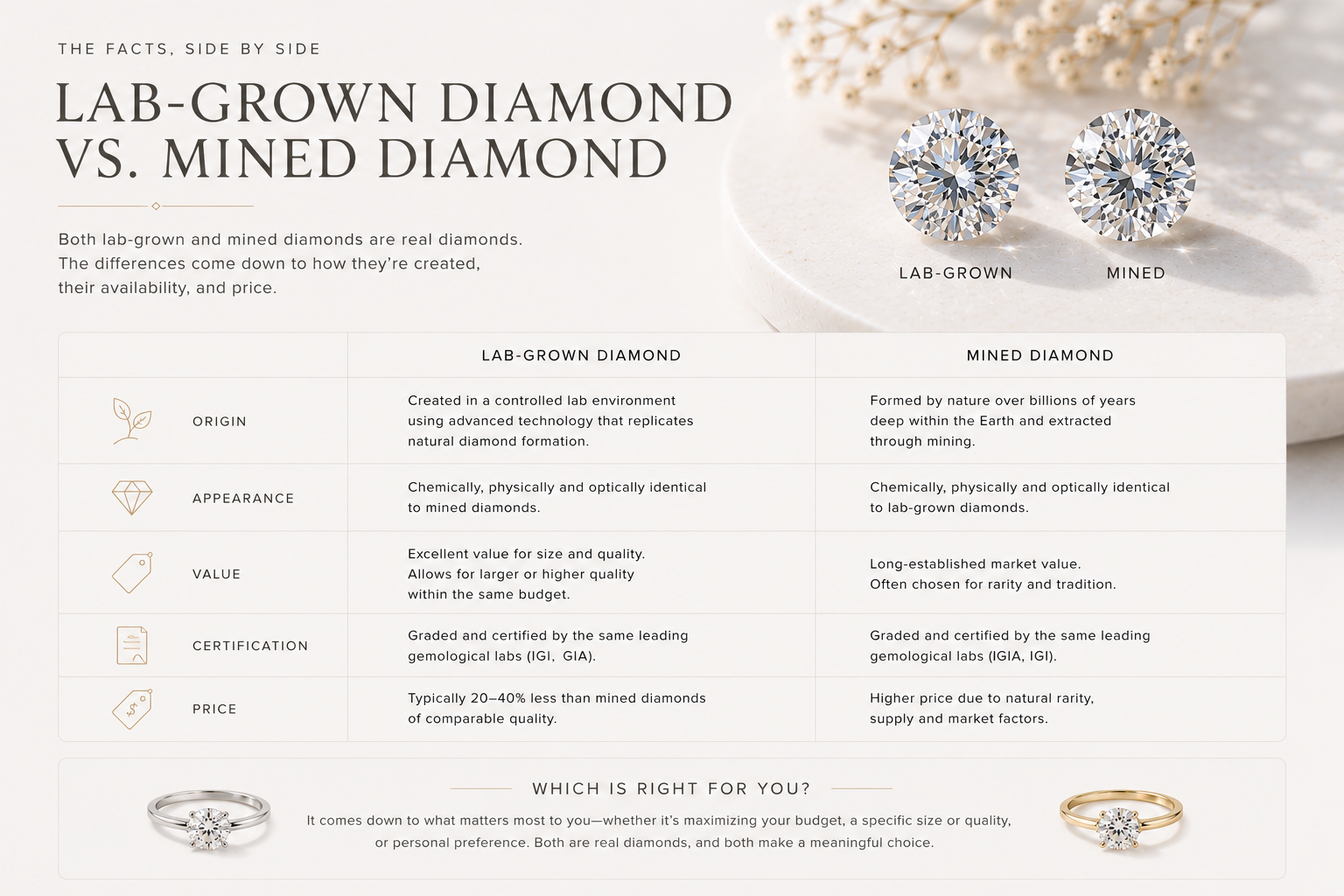
Lab-grown diamonds and mined diamonds can look the same to the eye when cut well, but they differ in origin, pricing, value profile and buyer meaning. This page compares them clearly without moral grandstanding or pretending one choice is automatically better for every client.
Lab-grown vs mined diamond at a glance.
The difference is not usually what the diamond looks like on the hand. The bigger difference is origin, price, meaning and long-term value expectation.
Point
What to compare
Lab-Grown Diamond
Laboratory origin
Mined Diamond
Natural underground origin
Origin
Lab-grown diamonds are created in a controlled laboratory environment.
Mined diamonds form naturally underground and are recovered through mining.
Appearance
A well-cut lab-grown diamond can look the same as a mined diamond to the eye.
A well-cut mined diamond can look the same as a lab-grown diamond to the eye.
Composition
Lab-grown diamonds are diamonds with a carbon crystal structure.
Mined diamonds are also diamonds with a carbon crystal structure.
Price
Lab-grown diamonds usually allow larger size or higher specifications within a given budget.
Mined diamonds usually cost more than lab-grown diamonds of similar visible specifications.
Certification
Lab-grown diamonds can be certified, with reports identifying laboratory origin.
Mined diamonds can also be certified, with reports identifying natural origin.
Value Profile
Lab-grown diamonds are usually chosen for beauty, size and budget flexibility rather than resale value.
Mined diamonds usually carry stronger traditional market identity, but still should not be sold as guaranteed investments.
The cleanest difference is origin.
Lab-grown diamonds are grown in a controlled laboratory environment. Mined diamonds form naturally underground. Both are diamonds, but their origin stories are different, and clients should know exactly which one they are buying.
Appearance depends more on quality than origin.
A poorly selected diamond can disappoint whether it is lab-grown or mined. A well-cut diamond can be beautiful whether it is lab-grown or mined.
Cut, proportions, colour, clarity, carat and shape still matter.
The 4 CsCut
Cut affects sparkle and light performance more than many buyers realise.
Colour
Colour grade affects how white or warm the diamond appears in the final ring.
Clarity
Clarity matters most when inclusions are visible or when the shape makes them easier to see.
Lab-grown diamonds usually give more size for the budget.
For many clients, lab-grown diamonds make it easier to consider larger stones, higher specifications or more design detail within the same budget.
Lab-grown price advantage
Lab-grown diamonds are often more accessible than mined diamonds of similar visible size and quality.
Mined diamond premium
Mined diamonds usually carry a price premium linked to natural origin, rarity perception and traditional market identity.
Design flexibility
A lower centre-stone cost can leave more budget for setting details, metal choice or matching wedding band fit.
Value depends on what you mean by value.
Some clients mean visual size. Some mean tradition. Some mean resale. Some mean emotional value. These are not the same thing.
Visual value
Lab-grown diamonds can offer strong visual value because clients may be able to choose a larger or higher-specification stone.
Traditional value
Mined diamonds carry long-standing luxury identity and natural-origin meaning for many buyers.
Resale caution
Neither option should be casually sold as a guaranteed investment. Resale expectations should be handled honestly.
Certification confirms details, not emotion.
Diamond reports can help confirm specifications, origin disclosure and grading information. Certification can be useful for both lab-grown and mined diamonds, especially where exact specifications affect price.
Origin disclosure
A report can confirm whether a diamond is lab-grown or mined.
Specification clarity
Certification can show carat, colour, clarity and cut information where relevant.
Better comparison
Reports make it easier to compare diamonds on paper, but the final visual selection still matters.
Which one should you choose?
Choose the diamond that fits the client’s priorities. Do not force a moral argument. Do not make a lazy investment promise. Match the stone to the person, budget and meaning.
Choose lab-grown if
You want diamond composition, strong visual quality, larger size options and better budget flexibility.
Choose mined if
You value natural origin, traditional diamond identity and the market perception attached to mined stones.
Choose honestly
The best diamond is the one chosen with clear expectations around origin, cost, appearance and value.
Lab vs Mined Diamond FAQ
Are lab-grown diamonds real diamonds?
Yes. Lab-grown diamonds are real diamonds with a laboratory origin. They are not moissanite, cubic zirconia or imitation stones.
Can you see the difference between lab-grown and mined diamonds?
To the eye, a well-cut lab-grown diamond and a well-cut mined diamond can look the same. The main differences are origin, price, value profile and personal preference.
Which is better: lab-grown or mined diamond?
Neither is automatically better. Lab-grown diamonds often make sense for size and budget flexibility. Mined diamonds often make sense for traditional origin and market identity.
Do lab-grown diamonds hold value like mined diamonds?
Lab-grown diamonds usually have a different resale and value profile from mined diamonds. They should generally be bought for beauty, meaning and budget value rather than investment expectations.
Should I choose a certified diamond?
Certification can help confirm origin and specifications, especially for larger or higher-value stones. Whether certification is necessary depends on the stone, budget and client expectations.
Choose the diamond that matches the reason.
Lab-grown and mined diamonds can both be beautiful choices. The right decision depends on origin preference, budget, appearance, certification expectations and the meaning behind the ring.
Request A Custom Quote