 Custom
Quote
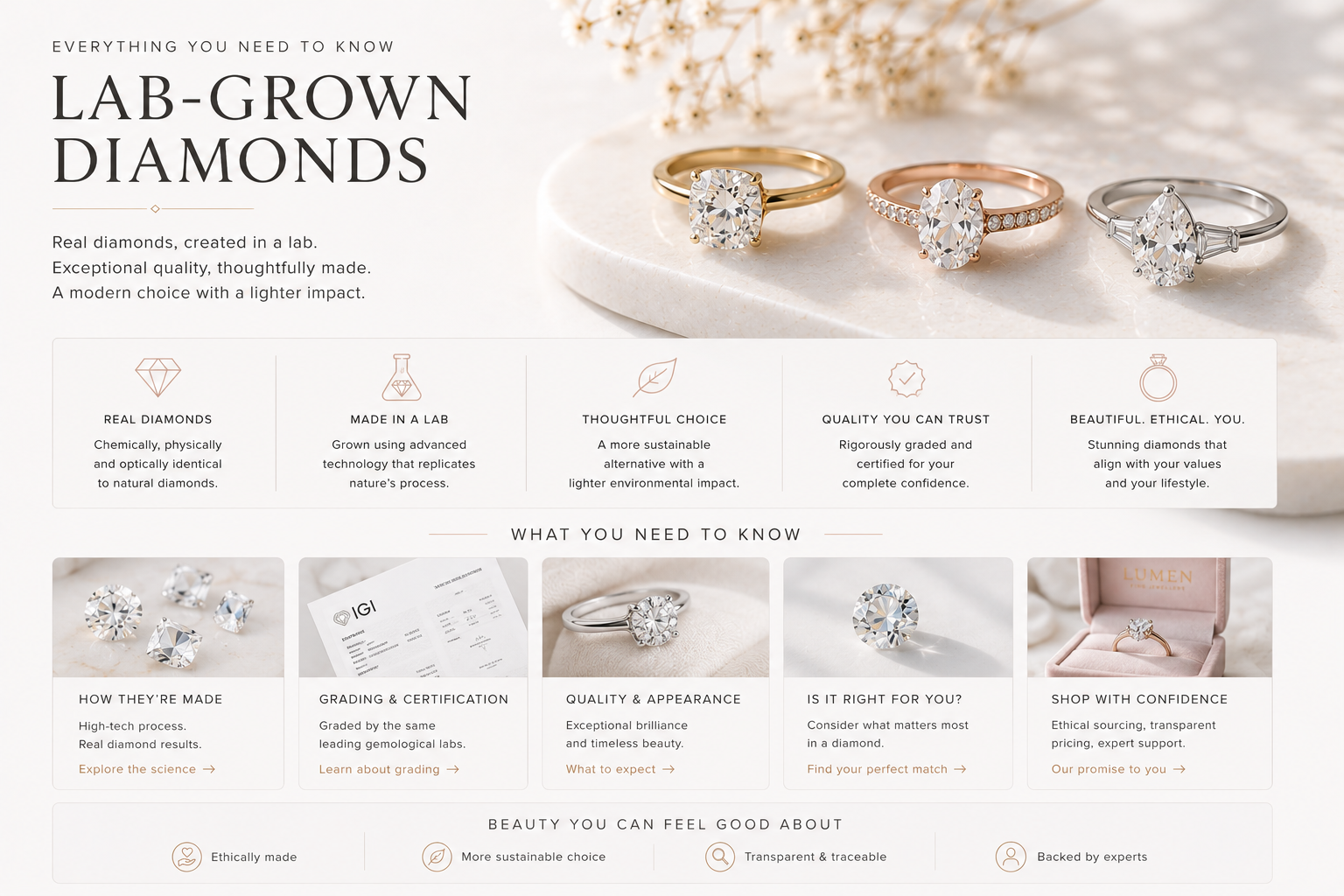
Real diamonds, grown above ground.
Lab-grown diamonds are real diamonds with a laboratory origin. They are not moissanite, cubic zirconia or imitation stones. This page explains what lab-grown diamonds are and when they make sense, without duplicating the deeper lab-vs-mined comparison page.
What is a lab-grown diamond?
A lab-grown diamond is a diamond created in a controlled laboratory environment. It has the same carbon crystal structure as a mined diamond, but a different origin story.
It is diamond
Lab-grown diamonds are diamonds. They are not simulants and should not be grouped together with moissanite or cubic zirconia.
It is lab-created
The origin is controlled laboratory growth instead of natural underground formation.
It can be graded
Lab-grown diamonds can be assessed by cut, colour, clarity and carat, with certification available where appropriate.
It has a different value profile
Lab-grown diamonds often provide excellent size and visual value, but resale expectations should be understood clearly.
Lab-grown diamonds are not moissanite.
This distinction matters. Lab-grown diamonds are diamonds. Moissanite is silicon carbide. Both can be beautiful, but they are not the same gemstone and should never be described as interchangeable.
When lab-grown diamonds make sense.
Lab-grown diamonds are often chosen by clients who want diamond appearance, diamond composition and more size or specification flexibility within their budget.
When size matters
Lab-grown diamonds can often allow clients to consider larger centre stones than similarly budgeted mined diamond options.
When the client wants diamond
Lab-grown diamonds suit clients who specifically want diamond, not moissanite or a diamond-looking alternative.
When clarity matters
Lab-grown diamonds can give more room to consider strong clarity, colour and cut combinations at a given budget.
Lab-grown diamond quality is still judged by diamond standards.
Lab-grown diamonds still need to be evaluated properly. The 4 Cs — cut, colour, clarity and carat — remain important.
A lab-grown diamond is not automatically beautiful simply because it is lab-grown. Cut, proportions and visible quality still matter.
The 4 CsCut
Cut strongly affects sparkle, light return and how alive the diamond appears.
Colour
Colour grade affects how white or warm a lab-grown diamond appears in the final ring.
Clarity
Clarity affects visible inclusions, but the right choice depends on size, shape and eye-clean appearance.
Certification can matter, but context matters too.
Lab-grown diamond certification can confirm important diamond details such as carat, colour, clarity, cut and origin disclosure. The importance of certification depends on the diamond, budget and client expectation.
For larger stones
Certification becomes more important when the stone is larger or when exact specifications strongly affect price.
For confidence
A report can help confirm what is being purchased and reduce uncertainty around the diamond.
For comparison
Certification can make it easier to compare one lab-grown diamond against another.
Lab-grown diamonds should be bought with realistic value expectations.
Lab-grown diamonds can offer excellent visual and budget value, but they should generally not be bought as guaranteed investment assets.
Beauty value
The main value is often in the size, look, sparkle and meaning of the finished piece.
Budget value
Lab-grown diamonds can help more of the budget go toward size, quality, metal or design detail.
Resale caution
Resale expectations should be handled carefully and honestly, especially as lab-grown diamond pricing can shift.
Lab-Grown Diamond FAQ
What are lab-grown diamonds?
Lab-grown diamonds are real diamonds created in a controlled laboratory environment. They have the same carbon crystal structure as mined diamonds, but they are grown above ground rather than formed naturally underground.
Are lab-grown diamonds real diamonds?
Yes. Lab-grown diamonds are diamonds. They are not moissanite, cubic zirconia or imitation stones. They are diamonds with a laboratory origin.
Do lab-grown diamonds look different from mined diamonds?
To the eye, a well-cut lab-grown diamond can look the same as a mined diamond. The main differences are origin, pricing, availability, value profile and personal preference.
Do lab-grown diamonds hold value?
Lab-grown diamonds should usually be bought for beauty, size, wearability and value-for-budget rather than as an investment asset. Their resale market is different from mined diamonds.
When do lab-grown diamonds make sense?
Lab-grown diamonds can make sense when the client wants a diamond, larger size options, good visual quality and better budget flexibility than many mined diamond options.
Choose lab-grown diamonds for the right reasons.
Lab-grown diamonds can be a strong choice when the client wants a real diamond, strong visual quality and more budget flexibility — with clear expectations around origin and value.
Request A Custom Quote