 Custom
Quote
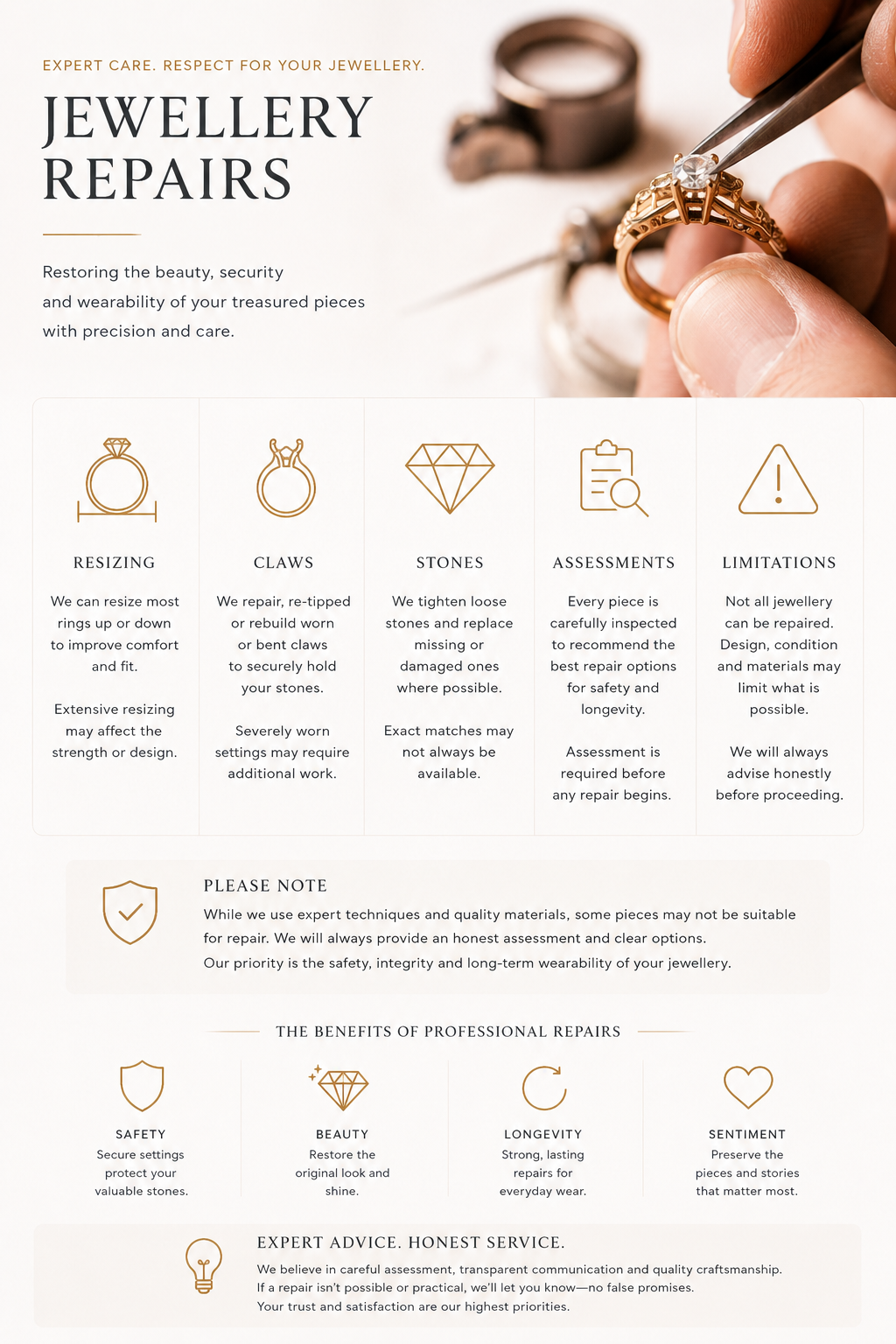
Repairing jewellery starts with an honest assessment.
Jewellery repairs can include resizing, claw work, stone replacement, cleaning, polishing and structural assessment, but not every repair is possible or wise. The right repair depends on the metal, setting, stone security, previous work, damage level and whether the piece can safely handle more work.
Why an assessment comes before a repair promise.
Fine jewellery can look simple from the outside, but repair work happens inside a structure that may already be worn, thin, cracked, stretched, bent or heat-sensitive. A proper assessment protects the jewellery and the client.
We check structure.
We look at the metal, thickness, cracks, bending, claw wear, setting strength, solder points and whether the piece can safely handle repair work.
We check stones.
Diamonds and gemstones react differently to heat, pressure and handling. Some stones must be removed before repair, and some may not be safe to work around.
We check history.
Previous resizing, soldering, polishing, third-party work or hidden damage can affect what is possible and whether repair is still the best route.
Common jewellery repair requests.
These are common repair categories, but each one still depends on inspection and suitability.
Ring resizing
Assessment-led resizing for suitable rings, including practical guidance around size changes, stone settings, metal type and design limitations.
Claw and prong work
Inspection, tightening, re-tipping or rebuilding of suitable claws where stones need improved security.
Stone replacement
Replacement of missing or damaged stones where the setting can safely hold a new stone and a suitable match can be sourced.
Stone resetting
Resetting stones into existing or new settings where the stone and jewellery structure allow safe work.
Cleaning and polishing
Professional finishing, cleaning and polishing where the piece has enough metal integrity and does not require deeper repair.
Repair assessment
A practical review of wear, damage, stone security, previous repairs and whether the jewellery is repairable.
Ring resizing is not always simple.
Plain bands are usually the most straightforward to resize. Detailed rings, thin rings, heavily set rings, full eternity bands, mixed metals and damaged rings need more caution.
A ring may be resizeable by one size but not safely resizeable by many sizes. Some rings may need rebuilding, remaking or redesigning instead.
Ring Size GuideSize movement
Small size changes are generally easier than large changes. Large changes may distort stone settings or ring shape.
Stone setting
Rings with stones around the band may be limited because resizing can loosen stones or alter spacing.
Engraving and detail
Engraving, patterns, two-tone sections and decorative details can be interrupted or lost during resizing.
A repair should not create a bigger problem than the original issue.
Sometimes the responsible answer is not “yes, we can repair it.” Sometimes the responsible answer is that the piece is too worn, the setting is too weak, the stone risk is too high, or a rebuild will protect the client better than repeated small repairs.
Claws, stones and setting security.
Loose stones, missing stones and worn claws should be assessed quickly. Small issues can become larger if jewellery continues to be worn while the setting is compromised.
Loose claws
A loose or lifted claw may sometimes be tightened. If metal is worn away, the claw may need re-tipping or rebuilding.
Missing stones
Replacement depends on matching size, shape, colour and type, and whether the setting still has enough structure to secure the new stone.
Damaged stones
Some chipped or damaged stones cannot be repaired. They may need replacement or resetting depending on severity and sentimental value.
Heat sensitivity
Some gemstones, treatments, enamel, pearls and glued components can be damaged by heat or ultrasonic cleaning.
Metal fatigue
Old, thin or repeatedly bent metal may crack or fail during repair even when handled carefully.
Third-party work
Previous work by another jeweller may affect structure, warranty and the ability to assess original craftsmanship.
When repair becomes remodelling.
If a piece carries sentimental stones but the setting is no longer safe, repair may not be the best option.
In those cases, resetting or remodelling the stones into a new design may protect the meaning of the jewellery better than forcing the old structure to keep working.
Stone Resetting GuideHow a repair usually works.
The exact process depends on the item, but most repair enquiries follow a practical assessment path.
Send photos
Clear photos help us understand the issue, although a final answer may still require in-person assessment.
Assessment
The piece is reviewed for metal condition, setting integrity, stone risk and whether the work is sensible.
Repair route
Where possible, we advise on resizing, claw work, stone replacement, polishing, resetting or remodelling.
Completion
The jewellery is repaired, cleaned and checked, with realistic guidance on future wear and maintenance.
Jewellery Repairs FAQ
Can every jewellery repair be done?
No. Not every jewellery repair is possible or sensible. Some pieces are too worn, too thin, too brittle, too previously repaired, too heat-sensitive or too structurally compromised to repair safely. OgilvieGems assesses the piece first before confirming whether a repair route is possible.
Can OgilvieGems resize any ring?
Ring resizing depends on the ring design, metal, stone setting, engraving, eternity detail, previous repairs and how many sizes the ring needs to move. Plain bands are usually simpler. Full eternity, heavily set, tension-style, delicate, hollow or damaged rings may be limited or unsuitable.
Can loose claws be repaired?
Loose or worn claws can often be tightened, re-tipped or rebuilt, but the correct repair depends on the metal condition, stone size, setting style and how much metal remains. If claws are too thin or the setting is distorted, a larger rebuild may be needed.
Can missing stones be replaced?
Missing stones can often be replaced if the setting is still suitable. The new stone must be matched as closely as possible for size, colour, shape and appearance, but an exact match is not always possible, especially with older, rare or natural stones.
Why must jewellery be assessed before quoting?
A proper assessment protects the client and the jeweller. Jewellery repairs involve metal fatigue, heat sensitivity, previous work, stone security and structural limits that cannot always be judged from a quick photo alone.
Can another jeweller repair an OgilvieGems ring?
Another jeweller may physically be able to work on the ring, but third-party repairs, resizing or modifications may affect OgilvieGems warranty coverage. Warranty-sensitive work should be assessed by OgilvieGems first.
Is a repair always cheaper than remaking the piece?
Not always. If a ring is badly worn, bent, cracked, over-polished or structurally weak, repeated repairs may cost more over time than rebuilding or remaking the piece properly.
Repair should protect the jewellery, not just hide the problem.
A good repair starts with honesty. If the piece can be safely restored, we will guide the repair route. If not, we will explain the limitation and help you consider the most sensible next step.
Ask About A Repair